


Matilde Risi believes that journalism should be founded on truth and is motivated to shed light on the obscurities and nuances that surround the political and social events influencing our lives. The words of Italian journalist and writer Oriana Fallaci, who once said, “There are moments in life when keeping silent becomes a fault, and speaking an obligation. A civic duty, a moral challenge, a categorical imperative from which we can’t escape,” continue to inspire her pursuit of fearless reporting.
Born in 2004 in Milan, where she spent her entire life, she eventually set her sights on new horizons and moved to Rome in pursuit of new opportunities.
Upon meeting Matilde, her attentive listening and effortless sense of humour immediately convey a sense of warmth. She pays close attention to others, making them feel heard, and her ability to joke and keep conversations light creates an atmosphere that is both open and comfortable.
She describes herself as a Negroni, a classic Italian cocktail made with gin, vermouth, and Campari: “bittersweet, bold, and not necessarily for everyone.” She is honest and direct, but also warm and sociable, always confident in who she is. For her, being open-minded, willing to listen, and engaging with perspectives different from her own is a core value.
It was her drive to engage with a multitude of ideas and perspectives, along with her passion for storytelling and truth-seeking, that led her from studying Economics and Business at Luiss University to working toward a master’s in journalism.
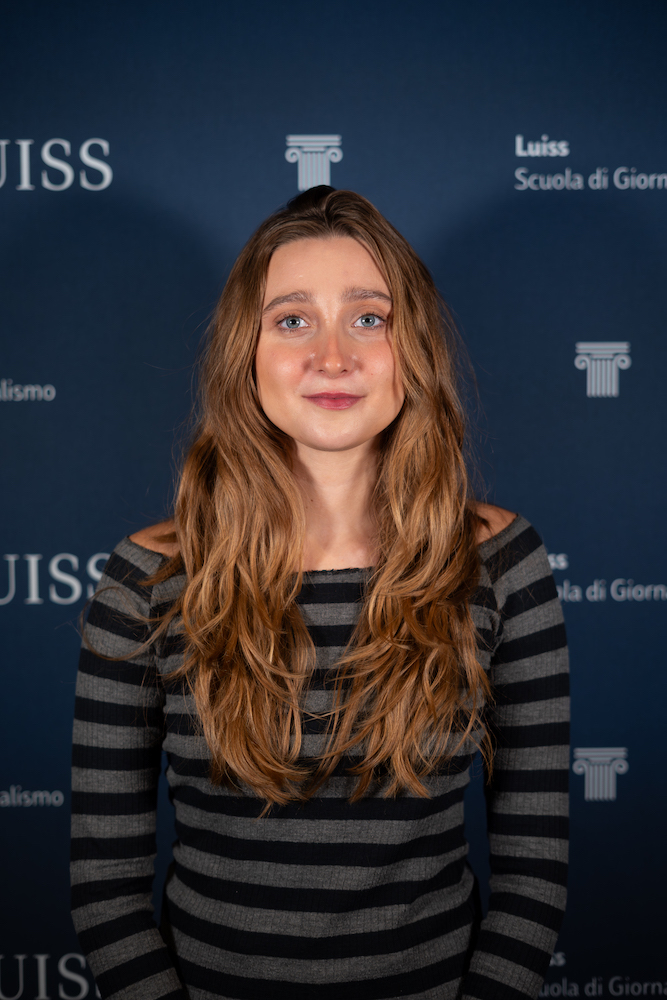
A moment that influenced her pursuit was her first volunteer experience in Romania. “I was confronted with the complex political and cultural realities of the region, and was struck by how different they were from the media narratives I had grown up.” This experience was transformative, planting the seed for what would become a strong belief: that journalism must report the truth. It marked a clear “before and after” in her worldview, solidifying her commitment to using media as a force for clarity and justice.
Her commitment to journalism is not only rooted in transformative experiences but also in the very fabric of her upbringing, where contrasting influences nurtured her unique way of seeing the world. Matilde has been profoundly shaped by her family, whose differing influences have defined much of who she is today.
She grew up between two opposite worlds. On one side are the scientists: relatives she calls the “statics,” who inhabit a universe governed by physics and mathematics, where every question has a precise answer and thinking tends to be linear, rational, and exact. On the other side are the artists, immersed in the abstract, a vibrant and fluid world of music and expression, where things are felt rather than calculated. Matilde, in many ways, is a fusion of both: curious, analytical, and grounded, yet also expressive, empathetic, and dynamic.
It is this combination of traits, along with the ideals of fearless reporting she admires, that has shaped her ambitions. Inspired by Fallaci’s belief in speaking out against injustice, Matilde aspires to become a war reporter, someone brave enough to seek and speak the truth even in dangerous or uncomfortable situations. Her deepest motivation lies in covering socio-political issues that are often overlooked. Whether abroad or closer to home, such as in the marginalized neighbourhoods on Milan’s periphery, “I want to give voice to those who are often unheard.”
When asked how she hopes to be remembered, Matilde is clear: she doesn’t strive for attention or fame for its own sake. In a world fixated on viral moments and media notoriety, she wants to leave a more meaningful legacy; someone who stood by her principles, acted with integrity, and truly tried to make a difference in the causes she cares about.