


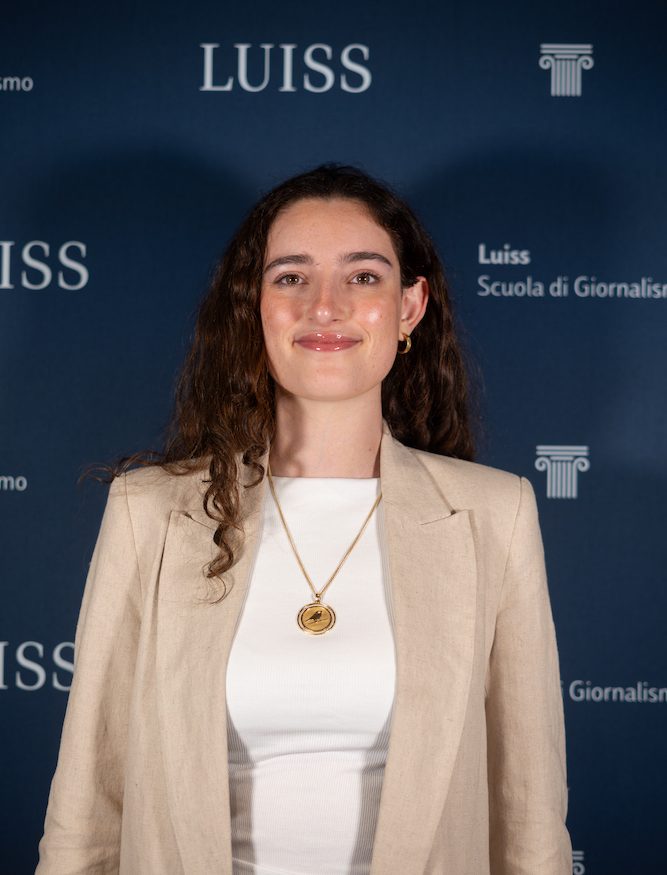
“I am a fruit of countless diverse graftings”; These Ungaretti’s words were the first that came to mind when meeting Salvatrice D’anna Campo, a singular presence, born of roots that weave together across cultures and horizons. In both her appearance and her voice, she carries the mark of her extravagant origins: Barcelona was the dawn of her story, yet her roots sink deeper in a Spanish Italian thread, rewoven in the charismatic environment of Peru. She is neither one land, nor one tongue; she is an Ungaretti fragment come alive, defying every attempt to be bound to a single identity.
An outsider by choice and by fate, she moves through cultures without surrendering to one. Shaped first by family, she inherited not only resilience but a vision: that education is no mere pursuit of facts, but the refusal to accept appearances at face value. This pursuit of genuineness extends beyond books into the way she relates to others. Grounded in herself, she does not chase masks. Salvatrice is a warm and thoughtful, yet reserved presence, her face a candid map of her inner world — transparent, unguarded, unwilling to conceal what she feels.
What she cannot abide is hypocrisy — empty words, hollow gestures, the laziness of encounters stripped of sincerity. She treasures individuality, yet mistrusts arrogance: the stubborn clinging to conviction without humility, without the courage to question oneself. For her, education, healthcare, and migration are not abstract debates but urgent causes, rooted in lived reality.
Out of this grows a conviction: that systems are not immutable. They can be unmade and remade; words must be measured and thought honed against the grit of reality. It is this refusal to accept appearances that gives her gaze its sharpness, its weight.
Her authenticity derives from a specific place: Peru. It was there, in the restless rhythms of the Global South, that she found a mirror unlike any other. Poverty and contradictions were not abstractions but lived realities, etching into her a new way of seeing, one that rejects illusion. She calls it a mutation, a transformation of perception: “without Peru, I would not know myself,” she says. From its landscapes grew her sensitivity to environment, context, and the socio-political currents that spill beyond borders.
This awakening soon deepened into a fascination with international relations and the fragile architectures of power. She traced how censorship erodes trust, how narratives are bent to serve empires. Books became instruments of clarity: Alessandro Orsini’s studies of power, John Mearsheimer’s work on the Israel lobby, and explorations of U.S. foreign policy. Through them, she confronted the empire of markets dressed as freedom, and the shadows cast across continents.
To speak of her is to speak of thresholds: between continents, between languages, between convictions and doubts. She lives in the space where borders dissolve, where identity is no longer a fixed inheritance but a perpetual creation.