
In the Space Race 2.0, the EU lags behind the traditional space giants from the Cold War Era’s race to the moon, but Italian scientists, government officials and private sector investors who spoke at the New Space Economy Forum in Rome hope to propel Europe into the future. But this time, the race is more of a marathon.
“That was a 100-meter sprint; today we are in a decades-long competition,” said Walter Villadei, astronaut and head of the Italian Air Force Houston office for commercial space flight.
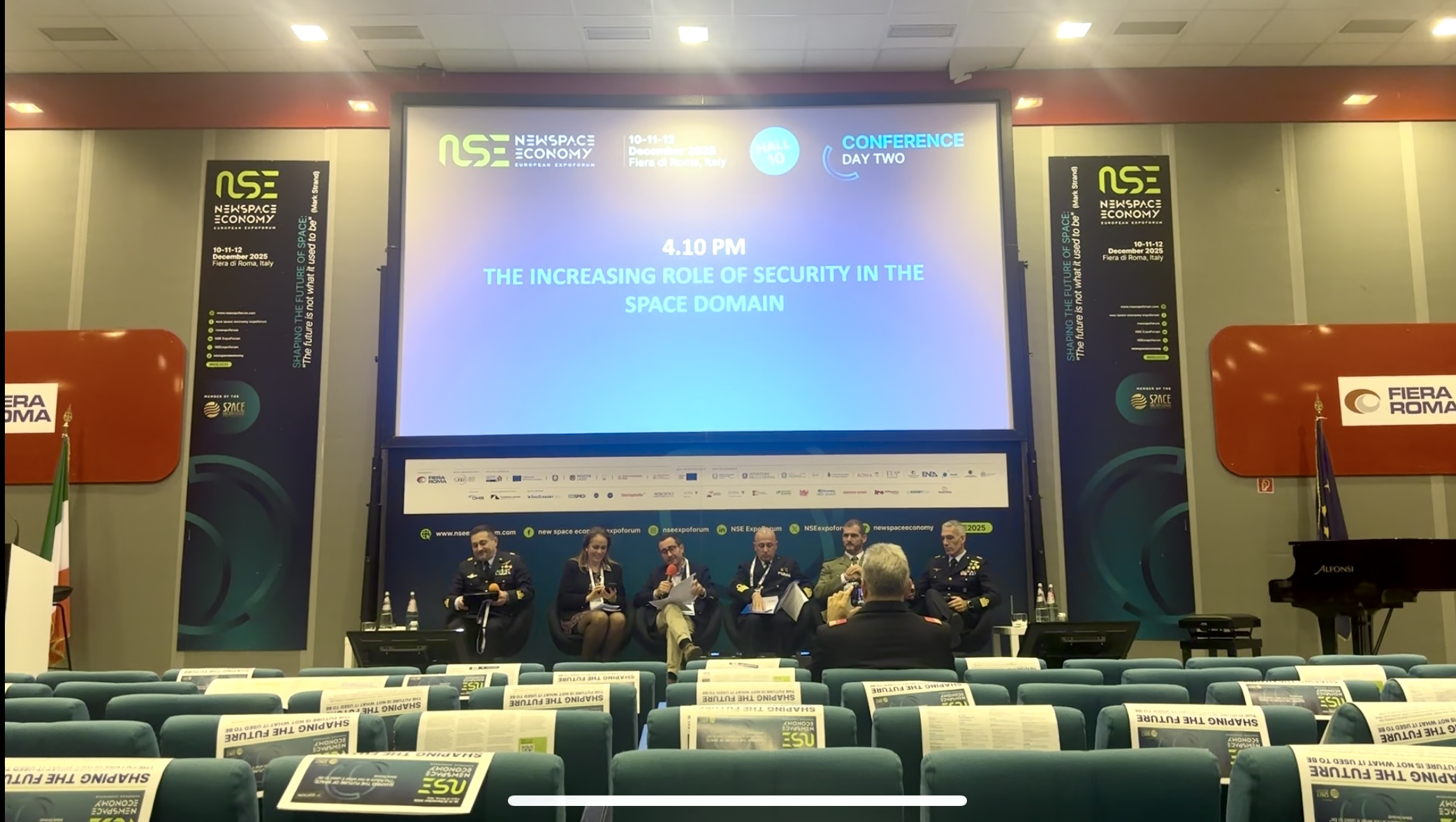
Speakers on the forum’s second day, Dec. 11, said space technology is improving human capability in communications, navigation, climate observation, surveillance and military operations, but funding gaps for could mean a weaken Europe’s power in the international community. “Europe has a technological gap to close with the major space powers and must invest in innovative, inter-operable common programs, exploiting emerging technologies while maintaining dialogue,” said General Roberto Del Vecchio, chief of the space policy office of the Italian Defense Ministry, at The Increasing Role of Security in the Space Domain conference.
Vecchio pointed to Italy as an example for European coordination with agencies to coordinate on security in space: the Agenzia Spaziale Italiana collects data on security and shares it with the Ministry of Defense, which can intervene in the case of threat. But, as a collective, Europe must bring in the private sector into space exploration as international relations increasingly includes multinational corporations, said Villadei.
“What we see today—companies such as SpaceX, Blue Origin and others shaping the next decades of space activities and exploration—is the result of choices and perspective shifts the United States began more than ten years ago,” said Villadei. “It requires dialogue between the public sector—which has operational needs—and private actors, who will build and operate new infrastructure.”
He told the audience that Italy is ahead compared to the rest of the continent in private investment, recounting his flight with Axiom Space, a private operator. But the ease of private investment in the U.S. investment into commercial space technology means it far outpaces Europe, though the two are allies in the “two emerging blocs” forming in the race to build space infrastructure in Earth’s low orbital area: “one led by the U.S., the other by Russia, China, and others.”
“The X-Files, a recent series offering a clever look at geopolitics and private actors on the Moon and in cislunar security, then on to Mars. . . It’s not so far-fetched,” said moderator Alessandro Marrone, head of defense, security and space at the Instituto Affari Internationali. He referred to a 2022 Chinese space mission where a satellite grabbed and pulled another defunct Chinese satellite out of orbit before replacing it. “You can understand both the technological demonstration and the military implications of such capability,” Marrone said.
But not private sector actors and governmental agencies do not always agree on where investment should go. At the Industrial Associations Role for Growth of the Space Economy conference, a member of ASI battled over the importance of services that use space technology with a representative of the ASAS, Association for Space-based Applications and Services
“You could support greater development in the services side. We always talk about satellite data,” said ASI Head of Strategic Coordination Augusto Cramarossa. ASAS president Leonardo Gagliardi countered that a small fraction of space missions are for services versus space flights: “The two percent, in my view, is the revenue you get from services using Earth observation systems… If someone has to invest, why should I invest in the two percent?” Cramarossa replied that global spending on services is high, and companies should see the value in the data collected.
“The problem is that in Italy there aren’t many companies exploiting that gold mine of data we have,” Cramarossa said.
Yet, Zuzana Mazanova, head of the space single market unit of the EU’s Directorate-General for Defence Industry and Space, said the EU has progressed on its goals toward space. She said the commission has delivered on most of the 2023 Space Strategy for Security and Defense, including forming an information sharing center and coordinating Earth observation services. She said future plans include the Multi-annual Financial Framework to fund further innovations and creating government sectors for each industry involved in space, such as surveillance and navigation.
In the new age of space competition with no clear end in sight, Villadei said “Europe could have a role; Italy could have a role.”