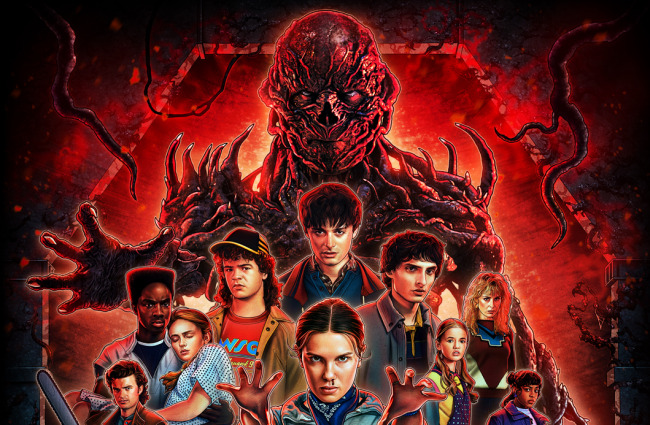

The tv series Stranger Things comes back with four new episodes, released on November 26, that feel less like a bid to outdo the past and more like a deliberate act of refinement. The series, produced by Netflix and created by the Duffer Brothers, that once thrived on velocity — plot twists, monsters, cliff-hangers — now shows a surprising confidence in stillness. It is a return that does not reinvent the show but rebalances it.
After the events of Season 4, the story resumes in a Hawkins that has been physically torn apart by Vecna’s failed attempt to collapse the Upside Down into the real world. Instead of becoming a permanent hellscape, the town is sealed off under a heavy military quarantine: a vast base has been established inside the Upside Down, and the army controls access, supplies, and even the health of residents. Officially, it was an earthquake; in reality, Hawkins exists as a tightly monitored limbo. Yet within this artificial enclosure, life goes on with eerie normality — schools remain open, shops operate as usual, cinemas screen mainstream hits, and family routines persist. The contrast is deliberately unsettling, but the series now seems less interested in exploring the social consequences of this devastation than in pushing toward a final hunt for Vecna. The narrative refocuses on the original group, revealing a tension at its core: Eleven, hidden in the woods and trained as both weapon and saviour, embodies the paradox of a messianic heroine trapped in adolescent longing, while the rest of the group appears emotionally frozen, still replaying familiar dynamics despite having outgrown them.
The most immediately striking element is the photography. The new episodes continue the cinematic turn that began in the later seasons, but with greater restraint. The lighting is moodier, more textured: interiors are often sculpted by pockets of shadow rather than washed in nostalgic glow, while exteriors lean into wide compositions that emphasize isolation rather than spectacle. The Upside Down feels less like a visual gimmick and more like an atmosphere that seeps into the frame. This is a significant evolution from Season 1’s Spielbergian clarity and even from Season 4’s operatic excess. The camera now lingers, allowing unease to accumulate rather than erupt.
Direction follows the same logic. The episodes are paced with an unusual patience for a series built on binge-ability. Several scenes unfold in long takes or carefully choreographed shot–reverse-shot patterns, privileging reaction over action. It is a choice that pays off especially in moments of interpersonal tension: the directors seem more interested in how characters absorb fear, guilt, or hope than in how they escape it. In this sense, the show recalls the quieter horror of The X-Files at its best, where dread emerged from implication rather than confrontation.
Dialogue has matured. The trademark banter is still present, but it has been subtly recalibrated. Jokes are no longer deployed as constant pressure valves; instead, they are spaced out, often carrying a tinge of melancholy. Conversations feel more economical, occasionally even awkward, as if the characters are aware of the weight of their shared past. Compared to the rapid-fire exchanges of Season 3, these dialogues suggest a series that trusts silence as much as wit. The writing allows emotional subtext to surface without over-articulation, a welcome contrast to the exposition-heavy stretches that characterized earlier climaxes.
Crucially, the new episodes are in continuous conversation with the show’s own history —but not always comfortably. Visual motifs — bikes, corridors, doorways — echo Season 1, but they are reframed through a darker, more introspective lens. Where early seasons relied on 1980s adventure nostalgia, the current instalment often foregrounds the psychological cost of survival. The protagonists, once brimming with wide-eyed curiosity, now exhibit behaviours marked by trauma, inertia, or unresolved longing. This is particularly evident in how the series grapples with what it means to grow up in a world that never lets its heroes rest.
These four episodes feel less like a sprint toward an ending than a moment of reckoning. Stranger Things has reached a stage where spectacle is no longer its main challenge; meaning is. Its greatest strength lies in the pauses, in the glances and silences that acknowledge time, loss, and fatigue. Its greatest risk is mistaking familiarity for depth. As it edges toward its conclusion, Stranger Things seems most compelling when it stops chasing the next threat and instead confronts the cost of having survived so many of them — suggesting that, in the end, growing up may be the most unsettling territory it has left to explore. The journey into this quieter, more introspective Hawkins continues, with Volume 2 new episodes set to arrive on Christmas Day.