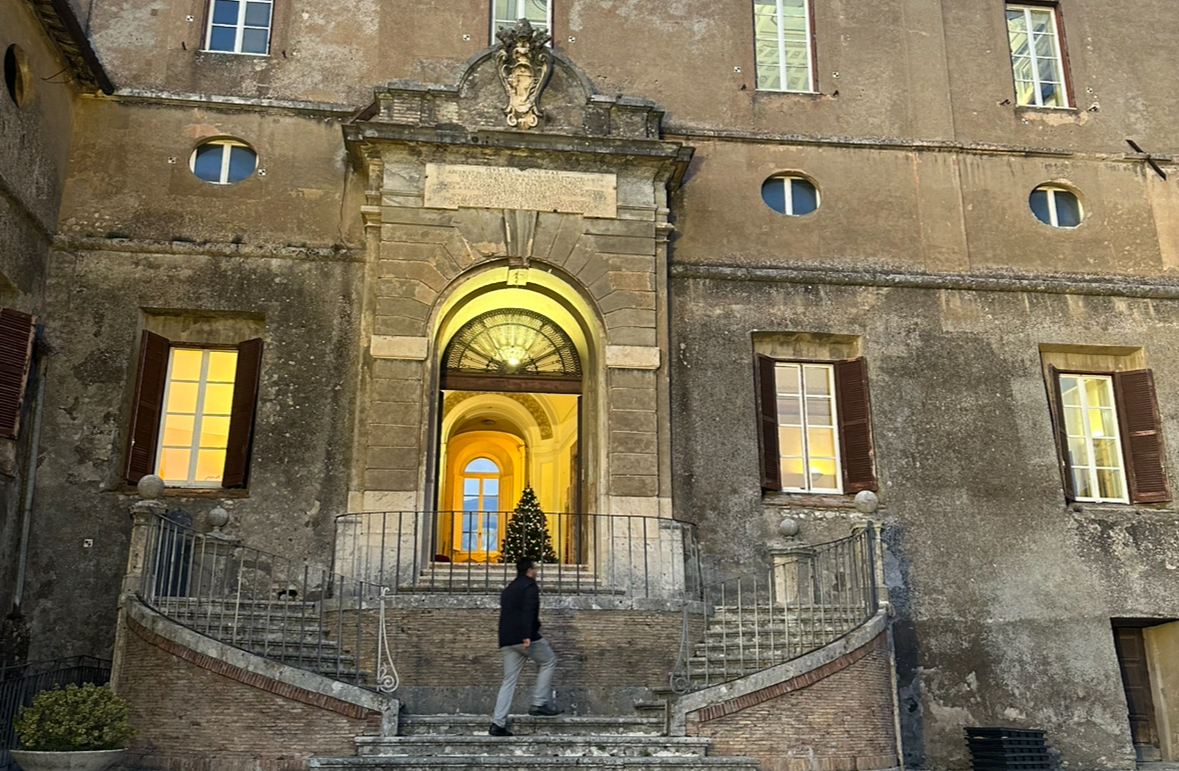

Outside the bustling city and touristic monuments of Rome, nestled in between mountains and hills, are Medieval stone towers and Renaissance frescoes. Small groups of visitors made their way to local historic home registered under the Rete delle Dimore Storiche del Lazio (Network of Historic Residences of Lazio), a source of pride for the little-known areas.
In Subiaco, the Rocca Abbaziale castle was one of 89 historic homes that opened for free the weekend of December 13 and 14, as well as on November 22 and 23. A Christmas tree greeted visitors upon entering the doors of the stone building up the hill in the center of the town in December, and to the left, visitors could admire a new piece of art added to the centuries-old paintings and murals. A replication of a village market and Subiaco’s weathering, brick-exposed buildings might not look like a nativity scene at first, but a closer look at the bridge in the center revealed figurines of Joseph and Mary amid the vendors selling their wares.
The interpretation of the classic birth of Christ might help Rocca Abbaziale preserve its history. The organization announced that the Lazio Region, in partnership with the Lazio Innova department, will award the home with the best Christmas display a €5,000 grant. The exhibit should represent the unique historical and cultural traditions of the town. The organization accepted all applications for the competition on December 18. The winner has not been announced yet.

For less well-known heritage sites, special openings and increased funds could attract more visitors to learn about often forgotten parts of Italian history outside of Rome and the more popular estates in Tivoli. Rocca Abbaziale’s coordinator Paolo Sbraga told the story of how Subiaco became the site of the first printed book in Italy in 1464. “Two guys from Mainz came down from Germany and they decided to stay here in Subiaco, not Florence, not Milan, not Venice, not Rome,” Sbraga said, and they brought movable type to the town.
The castle itself was built in the 11th century as a fortress and has since been influenced by powerful figures in the Catholic Church throughout history. In the 15th century, Spanish Cardinal Rodrigo Borgia, who later became Pope Alexander VI, governed over Subiaco and built the estate’s quadrangular tower. His illegitimate daughter, Lucrezia Borgia, might have been born in the fortress, according to the estate’s website. The last part of the building was built by Pope Pius VI at the end of the 18th century.
“It’s very particular story and it’s very strange that this big page of history is linked to a very small place as is Subiaco. This castle show us the power of the abbots, of the monks in the Middle Age, but also the power of the church and how important was this this power to determine the future that the story of all this land.”
In the municipality of Poli, Palazzo Conti also created their own nativity scene. The display of tree-like structures surrounding the figurines showing the arrival of the three kings, complete with farm animals and a miniature wagon, reflect the mansion’s origins as wooden structures. The wooden tower replica lit up by lights models the first wooden tower of the estate, dating back to the 9th century, tour guide Sergio Giubilei said. In the Middle Ages, the estate was reconstructed in a medieval style under the direction of the Oddoni family.

Giubilei said while the home is only open for official visits on Saturday, a member of the Palazzo Conti’s team is almost always available to guide visitors through its rich history. While on the 11:30 a.m. tour, some visitors arrived late, and Giubilei went back up the stairs with them after the tour ended to talk to them about the history of the incomplete urban transformation of the mansion’s bare and mismatched back rooms and the small chapel, the alter filled with rusted religious trinkets. During the Renaissance up until the turn of the 19th century, the palazzo was the residence of the noble Conti family and the birthplace of Pope Innocent XIII, who held the papacy from 1721 to 1724.
Sbraga said that visitors should go to smaller historic sites to fully understand historic events that have a significant effect on the history of Italy. Even if the castle he runs doesn’t win the prize that could go toward restoring the home, Sbraga said he appreciates all the fixtures that show the life a place has lived. “This is a part of story that is possible to see through the walls, the holes, the paintings that describes the society of a long period.”