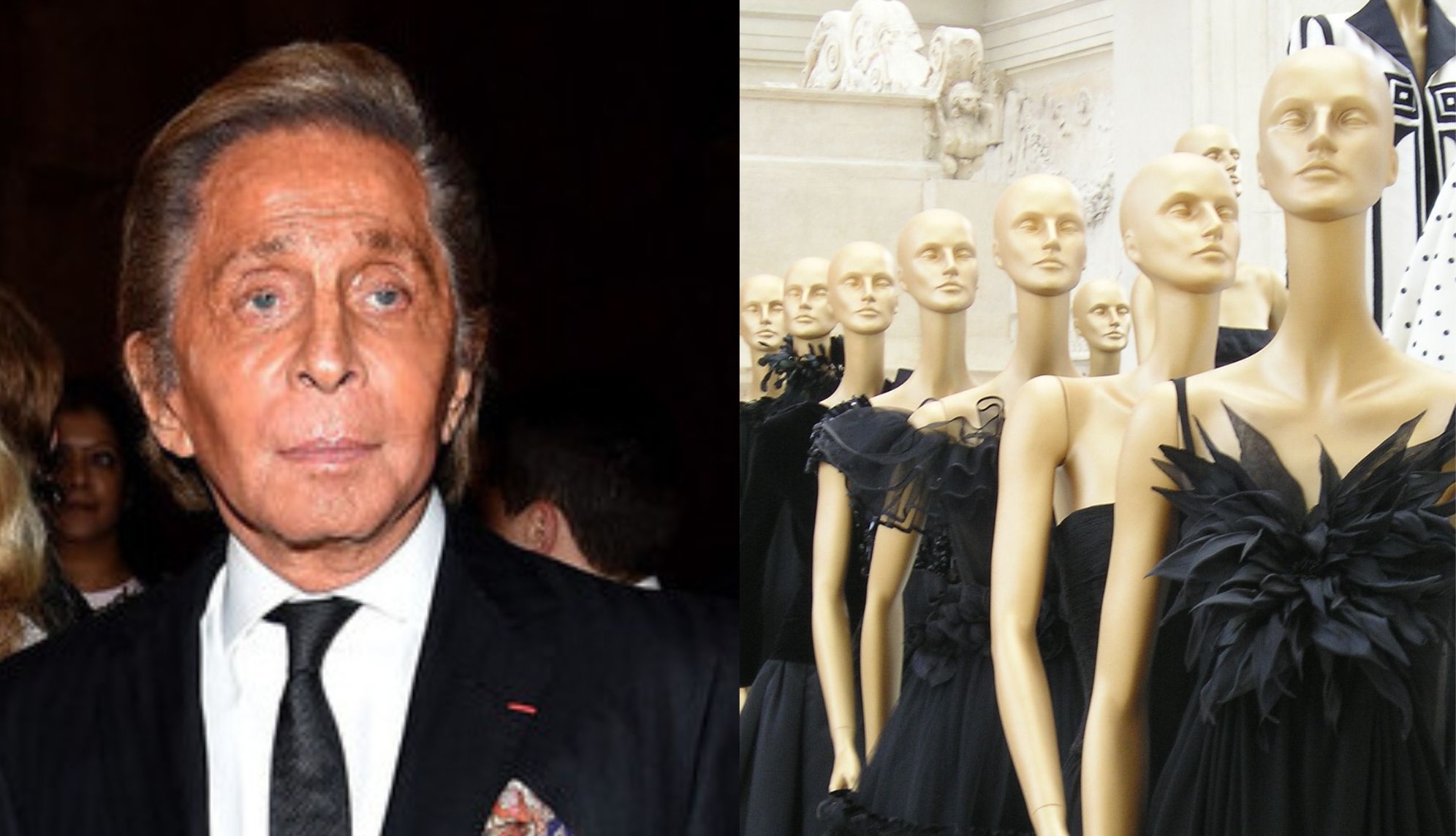

“I know what women want. They want to be beautiful.” Lover of elegance and simple luxury, designer Valentino Garavani, died the night of January 19 at the age of 93. Valentino brought haute couture to ready-to-wear fashion and created iconic looks for celebrities throughout several decades.
On the morning after his death, fashion and culture journalist Paola Cacianti put on a cashmere and lace shawl in the color of the famous “Valentino red” paired with red satin shoes with rhinestones, reminiscent of the brand’s studded pumps.
Cacianti spoke to Valentino two or three times a year for 25 years when he showed his ready-to-wear and haute couture collections in Paris, as well as his men’s collection in Milan. She told Zeta in a phone interview that when she read of Valentino’s death in the next day’s paper, she saw a historic photograph taken in 1980s by Corriere della Sera fashion journalist Adriana Mulassano of 12 historic Italian designers—which Cacianti called the “twelve apostles—” in front of the Milan Cathedral.
She said she felt that the era of “great fashion that began in the 60s and triumphed in the 90s” is being closed shut with the death of the 12 Italian fashion icons, all of which have died except for Anna Fendi. “It’s as if this photo, with those slightly cinematic effects, this year has faded twice, because Armani disappeared, and Valentino disappeared. It’s as if the photo were slowly erasing itself, telling you that this story is over.”
Garavani was born in Voghera, Italy in 1932. At 17 years old, he moved to Paris to study haute couture at the École de la Chambre Syndicale de la Couture. His brand’s origins are in Rome, when he founded Maison Valentino with business partner, Giancarlo Giammetti, in 1960. Valentino himself loved cinema, and by the end of the decade, he was dressing some of the biggest stars of the time, such as Elizabeth Taylor and Audrey Hepburn. When Jacqueline Kennedy chose to wear Valentino to marry Aristotle Onassis, Garavani earned his place among the greats of luxury fashion.
Cacianti was always interested in bringing culture into her reporting and said Valentino’s love of theatre and art resonated with her work. Valentino, she said, was kind and generous, and he made himself available to speak to journalists often. She was also struck by how he treated his models backstage as opposed to other designers who were sometimes “brusque, unpleasant, aggressive.” “Even in the greatest chaos of the fashion shows—because shows are great chaos behind the scenes—he maintained his courtesy and his gentleness.”
In 1998, Garavani and Giammetti sold the fashion house to Holding di Partecipazioni Industriali after a fall in the brand’s profitability, and in 2002, it was sold again to Italian textile conglomerate Marzotto, which also owned Hugo Boss. Although Valentino remained the creative director, he often clashed with the owners who were involved in mass market brands as opposed to couture. It was during this time when Cacianti said Valentino told her something she would never forget: “You know, in life, to endure you need above all one quality: patience.”
At the start of the new millennium, Cacianti attended her favorite Valentino event to date—the 40th anniversary show on at the Temple of Venus on the Aventine Hill, facing the Colosseum. She said the show was attended by big names, Gwyneth Paltrow and Liza Minnelli to name a few, and described the night as “full of light” and “an absolutely crazy evening.”
Garavani retired as creative director in 2007, but he remained involved in the brand and with the designers who took over the Valentino Group. The brand was taken up by Alessandra Facchinetti, who was quickly replaced by Maria Grazia Chiuri and Pierpaolo Piccioli in 2008. Chiuri left the role for Piccioli alone in 2016, and Alessandro Michele was appointed to the position in 2024. Private equity fund Permira had bought the company in 2007, but in 2012, Qatari investment fund Mayhoola for Investments acquired Valentino and continues to own the company today.
The Valentino Foundation is still in Rome’s Piazza Mignanelli, but for Cacianti, “Valentino remains incomparable and unique.” No one can replace the “gentlemen immortalized in that photograph” taken in Milan. Back then, fashion wasn’t about the mass market, conglomerates, or even brand name, but about the designer behind the brand, she said.
“Today, fashion, in order to be original, also tends to be ugly, and tends to make women look like strange characters. They invent a thousand things that may be original and fun, but that don’t help create the beauty of the person wearing them.”
For Cacianti, she keeps Valentino’s memory alive in the 70s-era Valentino dress in her closet given to her before she began working in fashion, a brown chenille dress with a scarf collar covered in printed yellow turtles. Valentino’s funeral will take place January 23 at the Basilica Santa Maria degli Angeli e dei Martiri in Piazza della Repubblica in Rome at 11 a.m.