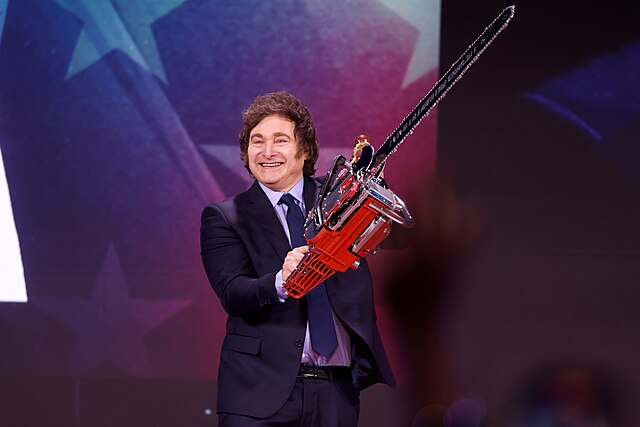

Argentina has rewritten its labour code. What President Javier Milei calls a “modernisation” reform is, for the trade unions, a “return to the 19th century”.
On 20 February 2026, the Chamber of Deputies approved the reform, modifying pillars that had remained largely unchanged since the 1970s. After undergoing some changes, it will now return to the Senate for a final vote scheduled for early March. If approved, Milei will sign the decree to make it law.
With the reform, the working day can be extended to twelve hours through company contracts, and the probationary period is increased from three to six months, during which employment can be terminated without compensation. The rules on dismissal are also changing. Bonuses and thirteenth-month payments are excluded from the calculation of compensation.
Ana Natalucci, a political sociologist at the University of Buenos Aires, who has been studying labour and trade unions for over twenty years, explains how these changes fit into the social and economic structure of the country.
At the heart of this shift is the dismantling of the values of Peronism, the movement that emerged in the 1940s under the leadership of Juan Domingo Perón. Rooted in a vision of social justice, Peronism cast the state as the guarantor of workers’ rights and the driver of wealth redistribution. It was Peronism that brought previously unimaginable protections into workers’ homes, transforming the descamisados, the “shirtless ones,” into the beating heart of the nation.
“Those laws were ahead of their time,” says Natalucci, recalling how they forged a social contract that included paid holidays, a thirteenth month’s salary, union-provided healthcare, and opportunities for social mobility. Peronism was not only a political force but also a promise of dignity.
“Today, informal workers already make up almost 45% of the workforce,” she explains. This problem is tied to recurring economic crises, high operating costs, and a vast underground economy that has never been fully integrated into the welfare system. According to Indec, since the start of Milei’s administration, more than 300,000 formal jobs have been lost, replaced by self-employment and undeclared work. Natalucci does not deny the need to modernize the system, but she criticizes the path that has been chosen. “The government is focusing on deregulation and cutting protections. It is a regressive reform.”
The reform abolishes sector-specific statutes, standardizing different trades under a single contractual category. It also introduces an “hour bank” system: work beyond eight hours a day would no longer be paid as overtime but instead accumulated as compensatory time off. Employees could work up to 12 hours a day without earning additional pay.
“It is not anti-union, it is in favour of greater opportunities and better pay,” Milei said in justification of the reform.
According to the government, the rigidity of the system discourages formal hiring and pushes employers toward undeclared work. It argues that the 1974 labour contract law, with its high payroll contributions and severance costs, has generated expensive and unpredictable litigation for businesses. In this view, hiring workers formally in Argentina has become both costly and risky, particularly for small and medium-sized enterprises.
The Minister for Deregulation, Federico Sturzenegger, said that one of the objectives of the reform is to “disarticulate the structure” of trade unions, reducing their bargaining power.
Under the reform, workplace assemblies would require the employer’s permission, and strikes in “essential services” would have to maintain up to 75% of normal operations, effectively limiting the right to protest.
“This is a government that has suspended mediation proceedings and introduced an anti-picket protocol with unprecedented levels of repression; you would have to go back to the dictatorship to find anything comparable,” the sociologist argues.
During the Senate debate on the reform on 11 and 12 February, a wall of federal agents dressed in black sealed off Congress, while armoured vehicles used water cannons to push back protesters. Molotov cocktails exploded in front of police lines as rubber bullets and tear gas shrouded the square in a thick white cloud. The Ministry of Security reported that at least 17 people were detained on charges of “terrorism”, a move widely seen by public opinion as yet another attempt to criminalise dissent.
On 19 February, the bustling capital took on the eerie atmosphere of a ghost town when the CGT, the main trade union confederation, called a 24-hour national strike. Major thoroughfares, including Av. 9 de Julio, were deserted, stripped of their frenetic traffic. “We are defending the rights that Javier Milei’s government wants to take from us. They are negotiating the biggest sell-off in the last 70 to 80 years,” says Jesica Gentile, a militant of the Movimiento Socialista de Trabajadores, who joined the streets to protest.
“We must not vote for the far right; we need to be careful not to be fooled by the smoke and mirrors that support a model of hyper-concentration of wealth in the hands of a few. Argentina should serve as an example of what not to do and whom not to vote for,” concludes Natalucci, letting out a bitter, restrained laugh, as if suddenly overwhelmed by the weight of everything that has happened and how the country has reached this point.