
Three years ago, the former journalist and now the head of the NGO Dialogue in Action was at the flash point of the invasion that surprised the world.
She watched as tanks from both countries rolled into battle from the window of her house in the Bucha region of Ukraine near the capital, Kyiv. The only news she had from the outside for two weeks was from a radio. After two weeks with no electricity, no service and dwindling food supplies, those in her house saw Ukrainian troops on the ground march into their village, and the troops told them the Russian army had entered her village. She and her neighbors got into nine cars headed west out of the district, all while shelling was happening along the road.
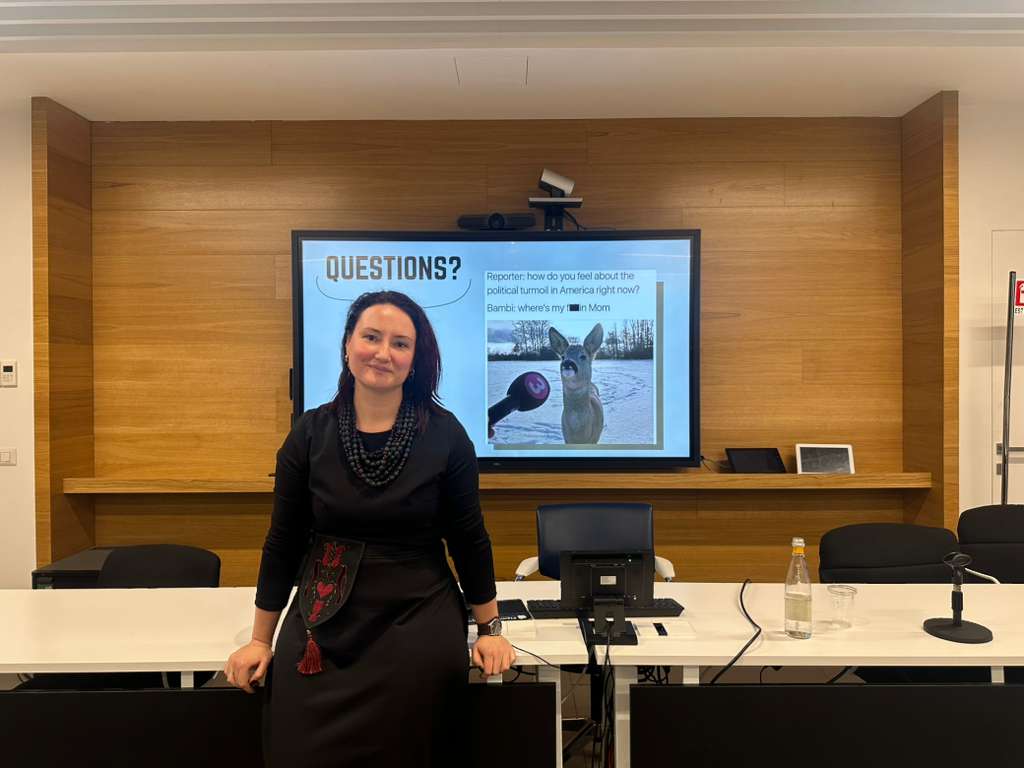
Kalenychenko spoke to journalism students at Luiss University at Viale Pola, 12, on Nov. 12 about her experiences as a journalist and activist in a war zone. “It was not expecting it,” Kalenychenko said about Russia’s invasion of Ukraine. “But after that, it was obvious for everyone every thing was under attack.”
Once out of Bucha, Kalenychenko used her resources to provide aid for those under occupation, specifically the Nemishayeve community inside the Bucha region. She used her contacts from her past as a journalist to create a network, and they were able to deliver food and medicine through a forest road Russian forces hadn’t discovered. They also brought people back in a small car one at a time, laying down on the floor of the car.
“It was really sensitive,” she said. “I prefer not to write than write, especially after the occupation. You never know how harmful it is.” After Russia’s one-month occupation of Bucha from March 4 to 31 of 2022, the district became a crime scene of war law violations. The Human Rights Watch documented hundreds of bodies on the ground, evidence of unlawful killing of civilians and indiscriminate shootings, kidnappings of male family members and bodies showing signs of torture.
The Russian Defense Ministry denied killing civilians on Telegram and called all photos and videos from the area a “hoax” and a “staged production.” By April 2022, authorities in Bucha reported more than 600 bodies in the district.
Kalenychenko said in text messages that she went back to Bucha after the occupation and provided aid on the ground from April to August of 2022. After that, she helped create the “Your Territory” Community Center, where she and a volunteer team host events, festivals and meetings to bring her people together. Though she did not report on the current war in Ukraine, she was a journalist during Russia’s occupation and annexation of Crimea. She left the field in 2016 to become a a public relations specialist at an NGO that specializes in bringing together religious activists of different religions that clashed with one another.
On the front lines of Crimea, she continued to break stories that angered some authorities in the country. She said she also talked to pro-Russian people to understand their points of view. Working in a war zone and covering religious conflict helped her understand the human impact of journalism, she said. During these last three years of war, Kalenychenko said she saw cases where telling people’s stories led to harm. She saw bodies, including of children, shown in the news without covering their faces, and families sometimes learned of their relatives’ deaths through social media. “For example, one of the families that was fully killed, except for the father, he saw these photos every day for one month. He was really traumatized, even more like remembering all the time,” she said.
Kalenychenko said the constant feed of the war on social media that she sees through her children sometimes makes her “more anxious” than when she was under siege in Bucha without around-the-clock knowledge of the destruction. Inside, she said some people try to find normalcy. “People are trying to get life back, to get some coffee, to get some fancy restaurant, anything just to feel alive,” she said.
Kalenychenko encouraged journalists to also tell positive stories about Ukrainian resistance, even if they don’t think the stories will not be “click leads.” When coverage of the war can lead journalists to become desensitized to violence, she warned not to reduce deaths as “just numbers.” In terms of peace, Kalenychenko said Ukraine must keep the unity between different ethnicities, religions and factions that the country has fostered to defend their country. “I don’t think it will be a quick process because we need a lot of changes,” she said. “But it would be good for us to change the system.”