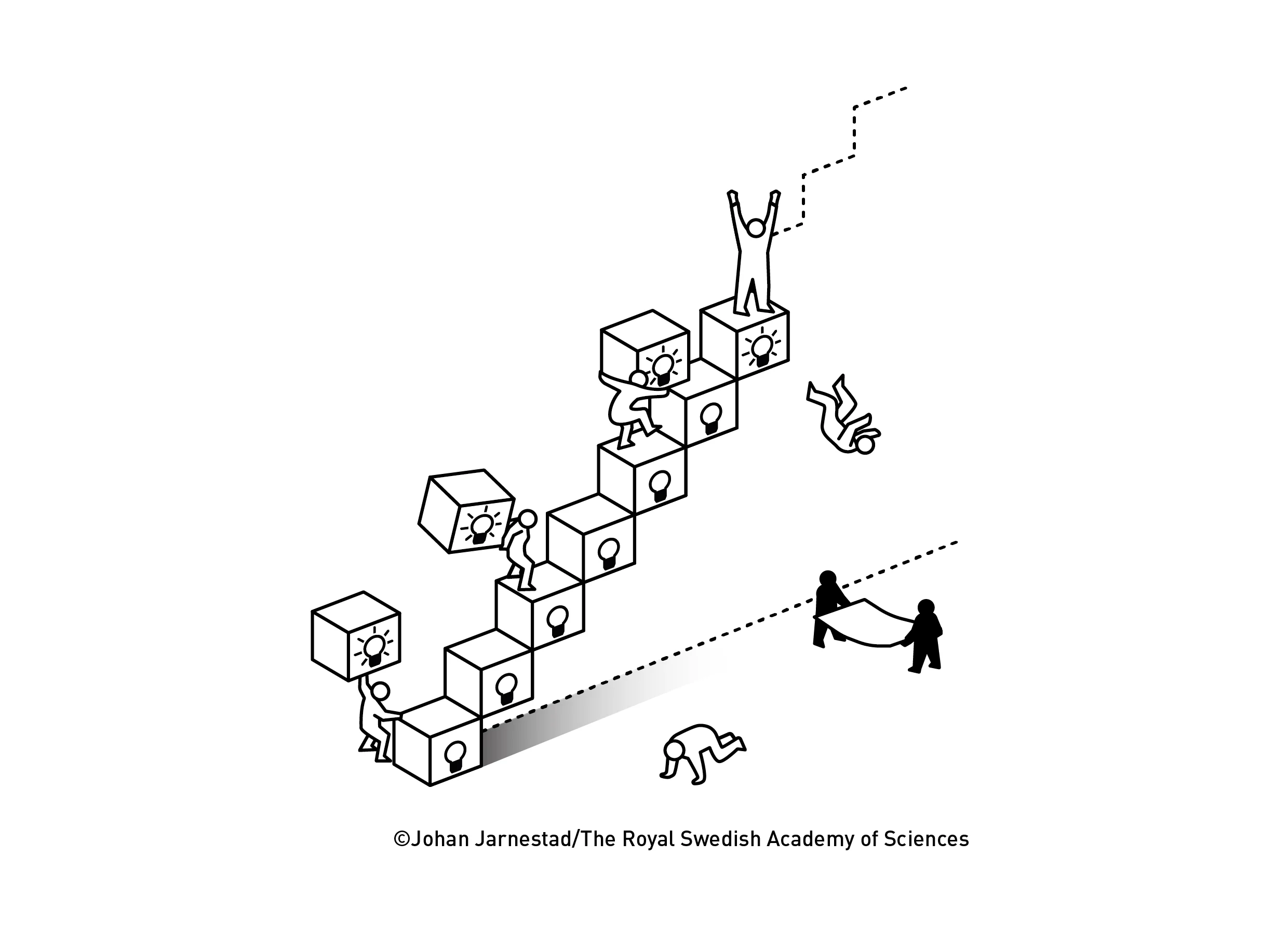

In a year when artificial intelligence and mass layoffs dominate the headlines, the Nobel Prize in Economics has gone to three scholars who have spent their careers studying how innovation shapes growth – and disruption. Half of the 2025 prize was awarded to Joel Mokyr, an Israeli-born American economic historian at Northwestern University, and the other half jointly to Philippe Aghion, a French economist at the Collège de France and INSEAD, and Peter Howitt, a Canadian economist at Brown University.
The Royal Swedish Academy honoured them “for having explained innovation-driven economic growth”. Their choice also confirms a recent trend: Mokyr is the second laureate in three years whose work is rooted in economic history, after Claudia Goldin in 2023, signalling the Academy’s growing interest in how a long-run, historical perspective can explain the evolution of economic systems.
Although they work in different branches of the discipline – Aghion and Howitt are macroeconomists – all three place innovation at the centre of their research. Seen from the twenty-first century, it is easy to treat innovation as a given. It’s a kind of optical illusion: when something has been around us for long enough, it starts to feel obvious.
Yet innovation is anything but obvious. Before the industrial era, no economist had imagined a system capable of renewing itself continuously through new technologies. Not even Karl Marx, the philosopher of “The Communist Manifesto”, whose theory of capitalism’s “destiny” many believe was disproved by the wave of continuous innovation that neither he nor his contemporaries could fully foresee.
For millennia the world economy was essentially stagnant. Important discoveries occasionally improved living conditions and raised incomes for a time, but growth ultimately petered out. This raises a fundamental question: what changed, at the end of the eighteenth century in England and then in Europe, that allowed innovation to transform our societies instead of fading away?
Mokyr’s work tackles precisely this question and highlights two key elements. The first is the dialogue between those who produce new ideas – scientists and engineers – and those who apply them in industry.
As Pietro Reichlin, professor of economics at Luiss, explains: “The classic counter-example that shows how important this connection is, is China. It was a forerunner in many major scientific discoveries, but those discoveries were not applied: they had no practical follow-up and therefore no impact on the economy. In Europe, by contrast, scientific discoveries found practical applications more easily, generating productive innovations.”
Paper, printing, gunpowder, the magnetic compass, sophisticated mechanical devices, clocks, astronomical instruments: China developed all of these centuries before Europe. Yet they did not trigger an industrial leap comparable to the European industrial revolutions.
The second element is political and cultural. In Europe, Reichlin continues, explaining Mokyr’s argument, “certain balances were broken, challenging monopolies and vested interests and opening the way to progress. Innovation is not just the isolated discovery of a new technology. It also depends on a cultural and institutional environment that allows it. There are regimes where innovation is viewed with suspicion because powerful interests want to preserve the status quo, and others where a context is created that allows the established order to be challenged. In Europe this happened for various reasons – above all thanks to political decentralisation between the seventeenth and eighteenth centuries, which generated competition between states. In essence, innovation stems from the freedom to break existing equilibria and from the space that is created for research and experimentation. That was the cultural climate of the Enlightenment, and it was a fundamental ingredient of modern growth.”
Innovation, however, also generates anxiety. The Academy’s announcement came just weeks before the new Challenger, Gray & Christmas report on U.S. job cuts: with 153,000 layoffs, October’s figure was the worst for that month since 2003 and almost three times higher than in the previous month. It is too early to unpack all the causes of this surge, but artificial intelligence is the chief suspect. Many American companies are eliminating entire layers of middle management and shrinking administrative staff. The American courier company UPS, for example, has reduced its operational workforce by far more than it had initially forecast, helped by increased automation.
We are witnessing in real time what Joseph Schumpeter called “creative destruction”. How worried should we be? According to Reichlin, “The introduction of radical innovations inevitably entails social costs in the short term. New technologies replace old ones, new production methods make previous ones obsolete, and many people may lose out initially. In a sufficiently competitive environment these costs are gradually absorbed, and in the long run the gains in terms of growth and productivity come through.”
Rising of inequality in the short term, however, is a concern for governments, which has to face with budget constraints and global competition, making redistribution harder. “Today innovations spread much faster on a global scale,” Reichlin notes, “allowing countries that were once ‘out of the game’ to compete. This does make it harder for individual states to intervene and manage major economic transformations on their own. On the other hand, we are collectively richer than in the past. We can afford welfare policies and measures to reduce inequality that would once have been unthinkable. More wealth also means more tax revenue that can be used to redistribute income. In short, both things are true and need to be kept in mind: global competition partly limits government action, but long-run growth provides more resources to cushion the negative effects. It is up to politics to strike a balance – to accompany the innovations that make us more prosperous, while distributing the costs and benefits of progress as fairly as possible.”
If we shift our gaze to Europe, one striking fact is that, according to CompaniesMarketCap.com, no European company appears among the world’s top thirty firms by market capitalization, and only ten of them are found in the top one hundred. For Aghion, this reflects a deeper problem: Europe is stuck in incremental innovation, specialising in refining and adapting technologies developed elsewhere rather than producing radical new ones.
Reichlin invites caution before drawing overly pessimistic conclusions. “Europe has a strong industrial base and, in the past, has generated considerable growth precisely by absorbing technologies introduced elsewhere – importing innovations from the United States and adopting new technological and managerial models. After all, innovators produce a public good: new ideas can be replicated, and once they emerge, others can benefit from them.”
When he accepted the Nobel, Aghion nonetheless warned about the “dark clouds” over future growth. Among them he highlighted the return of protectionism and the rise of dominant tech monopolies, which risk suffocating competition and slowing innovation.
Reichlin shares this concern. “The biggest risk for Europe today is a return to closed markets. If trade wars break out and barriers are erected that hinder the circulation of ideas and technologies, our continent will suffer greatly – especially given that we often fail to produce innovations as disruptive as those coming from the U.S. or China. If anything, Europe should aim to attract talent: it is worth remembering that many discoveries made in the United States came from researchers who had emigrated from Europe or other parts of the world.”
The 2025 Nobel Prize in Economics is, in this sense, both a celebration and a warning. It reminds us that sustained growth is not guaranteed: it depends on a fragile mix of scientific progress, open markets, and institutions willing to let new ideas overturn old privileges – while finding political ways to ensure that the gains from that disruption do not leave too many people behind.