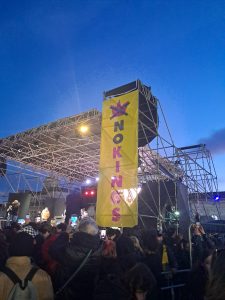
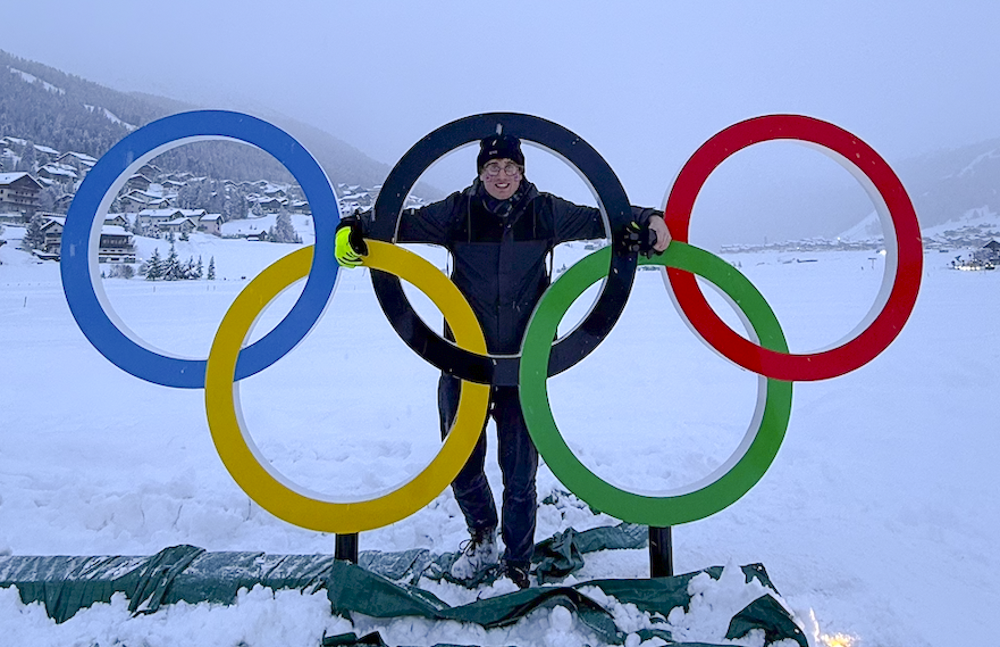

Under the floodlights, Cassie Sharpe soared four metres above the lip of the halfpipe into the alpine sky. The crowd tracked her in unison. One rotation. Two. Three. For a split second, the only sound was the light breeze and the hiss of steel on snow. With her skis flying, she fell in a crumpled heap at the bottom of the pipe.
For the hundreds packed into the finish area in Livigno, the Italian ski resort hosting the freestyle ski and snowboard events for the Milano-Cortina Winter Olympic Games, Sharpe’s fall was more than a missed landing. It was a reminder of the thin line between spectacle and danger that defines halfpipe, and of how quickly a night of celebration can tip into collective silence. In this tiny Alpine town transformed by the Games, being a fan means riding that emotional edge with every run.
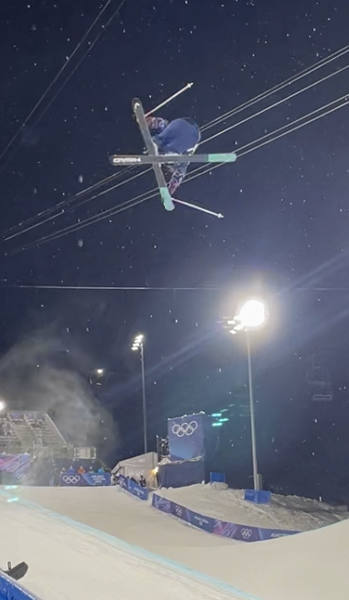
For Jeff Lucas, a Canadian fan, the edge is personal. He travelled from Vancouver Island, crossing an ocean and a continent to stand beneath the floodlights in Livigno. “She’s almost my niece,” he says of Cassie Sharpe. “She’s called me uncle for years.” Jeff was in the crowd when Sharpe won Olympic gold in PyeongChang, South Korea, in 2018, and again four years later when she took silver in Beijing, China.
As Sharpe drops in the halfpipe with each run, Jeff does not simply watch for amplitude or rotation. He sees a history of a kid he watched grow into a champion. Each spin carries memory, and each landing may have consequences. He watches the way family watches, willing her to rise, willing the landing to stick.
When she fell, the halfpipe stopped being a stage – the music faded, and the crowd fell quiet. As Sharpe lifted a hand from the stretcher, applause rippled through the finish area and a sigh of relief spread among strangers who, moments earlier, had shared nothing but the same fan zone and national flags. Among those flags is China’s, many of them there for Eileen Gu, the San Francisco-born skier who chose to compete for China and became one of the defining faces of Beijing 2022. Allegiance may begin with nationality, but under the lights it quickly dissolves into something more communal.
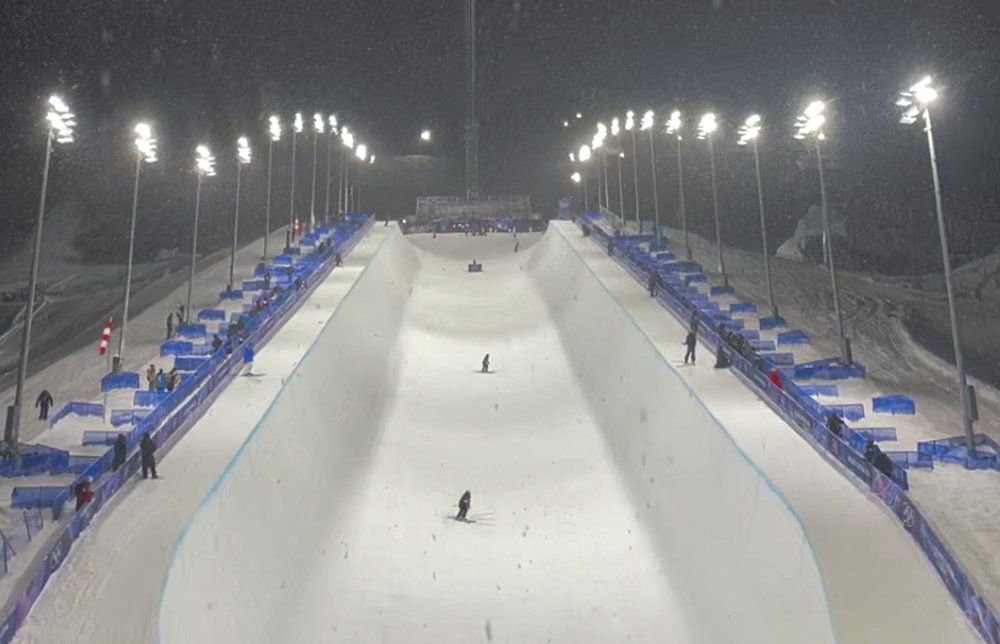
A few metres away, Janet Unwin, a British fan, watches the pipe with a different intensity. She made the journey from Essex, United Kingdom, with her son, cheering for Great Britain’s medal hopeful, Zoe Atkin. “We spent 6 hours waiting for the women’s big air in a storm the other night,” explains Janet. “I just really love the halfpipe,” she says, “it’s more exciting. They go so high. It’s just amazing.” When Zoe Atkin posted a 91.50 to lead qualifying, Janet had already made up her mind. “I thought she went a lot higher than everybody else. She did more grabs. The style was better.”
Judges weigh amplitude, difficulty and execution – how high a skier rises above the lip, the complexity of the rotations, and how clean the landings. Janet reads the pipe instinctively, tracking the control between hits, the fluidity from wall to wall, the confidence in the air.
When Sharpe lifted her hand from the stretcher, the response was the same in every language: a collective sigh of relief. Strangers from opposite ends of the world, clapping in the same cold air. The halfpipe is too fast, too high, and too dangerous for allegiance to hold. By the time a skier reaches the bottom, all you are is a person watching another person try not to fall.