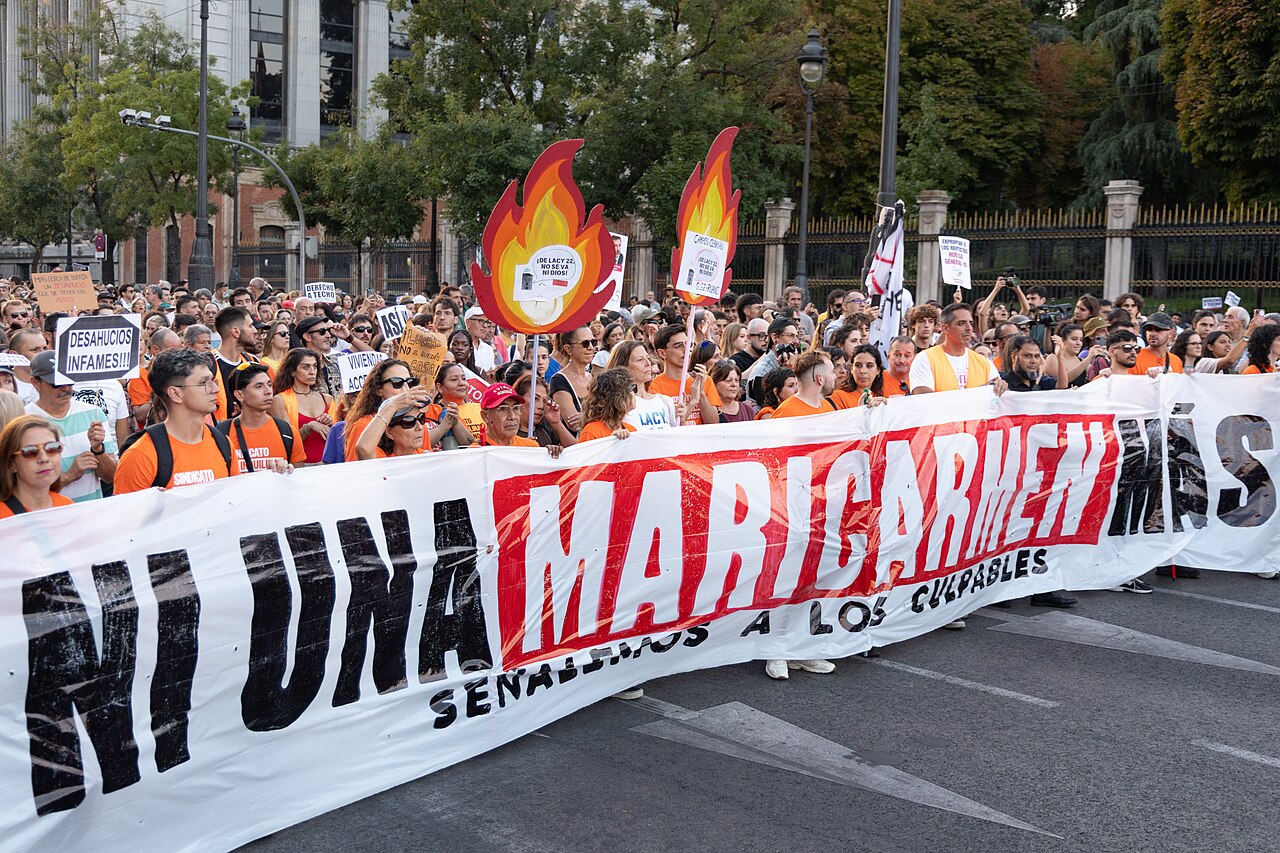

It was 1956 when Maricarmen Abascal moved into an apartment in Madrid’s Retiro neighbourhood with her family. Seventy years later, on September 23rd, 2026, the 87-year-old woman was forced to leave the house where she had spent almost her entire life. Just two weeks later, on October 7, she died in hospital, never having returned home.
Maricarmen’s story became a symbol of Spain’s deepening housing crisis, exposing the sad consequences of rising rents and the growing struggle to secure affordable accommodation. Her eviction came during mounting public frustration over the cost of living, sparking demonstrations throughout October and later to severe political consequences, as Pedro Sanchez, prime minister of Spain, called for early elections on November 29th after dissolving the parliament. The announcement arrives after the parliament’s rejection of two housing emergency decrees, uncovering Sanchez’s government weaknesses, not owning a decisive majority.
On November 11th Spain stopped moving. For the first time in 14 years the country called for a national strike, representing a unique event in Spanish history, as it is also taking place during a major electoral campaign. The 24 hour strike organized by the country’s biggest trade unions (UGT and CCOO), started at midnight on Wednesday restricting transportations and closing down factories, businesses and shops, causing a disruption in shipments and manufactoring, while pharmacies, restaurants and shops also remaind closed for the occasion. Madrid saw the greatest participation flow, with almost 120 thousand of people walking the streets of the capital, while Barcelona saw 55 thousand. A remarkable turnout for the event, where the protagonists were the younger generations, concerned for their future in their own land.
According to Spain’s Youth Council, average monthly rent stands at approximately €1,176, meaning that a young adult earning an average Spanish salary would have to allocate nearly 98.7% of their income to renting a home independently. Statistics show the difficulty and the significant limitations that younger generations are facing, but testimonies reveal the tragic situation even more. Almudena Lopez is a 74-year-old mother attending the manifestations and told Sky News: “My son is 43 years old and still doesn’t own a home as he cannot afford one”, she says her son works in IT and lives in a small room in a shared home. According to Lopez, purchasing a home for her generation required considerable sacrifices, but still remained a realistic possibility, today that possibility does not exist anymore.
The demonstrations, largely peaceful but saw episodes of tension and clashes with police in the bigger cities, reflect the atmosphere of political uncertainty in the country. With the elections approaching, Spain’s housing crisis has become not only a social emergency but also a fundamental issue in internal politics.
Following Sánchez’s decision on the 5th of October to call early elections, the conservative People’s Party (PP) has emerged as the leading contender, while Sánchez’s Spanish Socialist Workers’ Party (PSOE) struggles to regain electoral momentum. The party’s position was further impacted by the devastating train crash in Castilla-La Mancha on October 28, which caused 69 deaths. With the November 29 elections approaching, the PP maintains a significant lead, while the far-right Vox could play a decisive role in forming the next government.
Spain’s growing support for right-wing parties reflects a wider political transformation taking place across Europe. Germany with Alternative für Deutschland (AfD), far right party which saw a significant increase in its electoral consensus during the 2026 state election surges. Europe is facing an intense year of elections, opened by the Spanish election at the end of the month, which sees a growing consensus for conservative parties. Such phenomenon follows the increasing public anxiety on high migration numbers and housing crisis, which are used by PP and Vox in the electoral campaigns to win over Sánchez.
As the country prepares to vote, Spanish streets fill with flags, chants and anger. Protesters hope that stopping the country would crack down on real estate speculations and rental inaccessibility that would allow a future to younger generations in their country.