
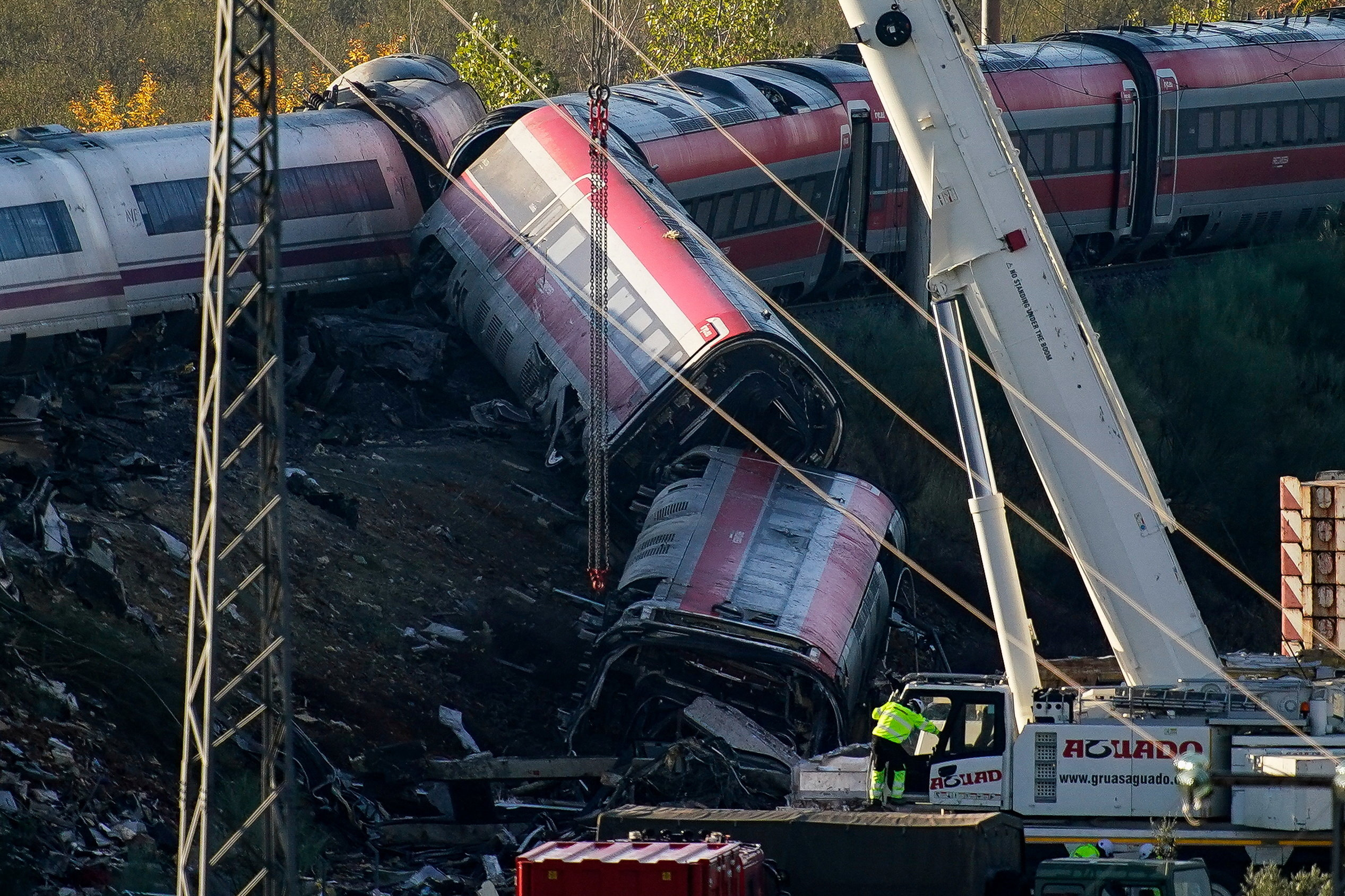

Two deadly crashes in less than a year prompted questions over railway safety to resurface following another deadly crash in the country in January. At least 69 people have been confirmed dead after two high-speed trains collided in central Spain. The deadly collision occurred on the morning of 28 October near Urda, in the province of Toledo, when a Renfe operated AVE train travelling from Madrid to Seville collided with a stationary Iryo operated train on the same track. Two of the Iryo train carriages rolled down the embankment. Nearly 80 people have been hospitalised, whilst Spain’s Minister of Health, Mónica García, says that 15 are “seriously injured”.
The same night more than 1000 people gathered outside Spain’s Transport Ministry in Madrid demanding accountability for the crash and calling for Transport Minister, Óscar Puentes, to resign. The demonstration was organised by far-right protesters and escalated into clashes with police, who used tear gas to disperse the crowd after protesters threw flares and other objects.
Authorities have yet to establish a definitive cause for the collision. Spain’s transport minister, Óscar Puente, said that the accident was caused by a communications malfunction and human error. Despite there being an active red signal, the Renfe train was mistakenly authorised to continue after an “inexplicable” order from a central command centre for Spain’s trains following a security system failure. However, the precise sequence of events, including the instructions issued by railway controllers and the safety measures in operation, remains under investigation.
Passenger on the high-speed train that crashed, Rafael Barceló, reported that “we were all thrown into the air”. He was situated in the cafeteria carriage at the time, having left his seat in the carriage which suffered the most damage, which may have saved his life. Another passenger, Tangui Binier, 22, recalled that “there were dead bodies, there were missing limbs. I don’t know if that is something I will ever recover from.”
This disaster comes nine months after a separate high-speed crash on the same line near Andaluz, in the province of Córdoba, which resulted in 46 deaths. The accident prompted scrutiny over Spain’s railway infrastructure after the train derailed due to a break in the track, and subsequently crossed onto the adjacent track where it fatally crashed.
Prime minister of Spain, Pedro Sánchez, has announced three days of mourning beginning on October 29, stating “we will do everything in our power to restore public confidence in our high-speed railway network. It is unacceptable for a country like Spain to experience two high-speed rail accidents in the same year.”
Although the circumstances of the two disasters appear different, their occurrence within the same year is bound to intensify questions over the safety of Spain’s extensive high-speed rail network. Spain has invested heavily in high-speed rail, connecting major cities through a vast network which serves millions of people. The latest collision has reignited the debate over whether Spain’s infrastructure maintenance, signaling technology, and operational safeguards are keeping pace with the demands being placed on the system.
A European Commission report comparing high-speed rail expenditure between 2018 and 2022 found that Spain spent on average €1.5 billion annually on its high-speed network, more than France or Germany. However, according to figures reported by Reuters, countries such as France, Germany, and Italy allocated approximately 34-39% of their high-speed rail spending to maintenance, renewals and upgrades, compared to only 16% in Spain.
The crash also comes at a politically sensitive time, with Spain due to hold a general election on November 29. The collision could intensify scrutiny of the government’s handling of railway safety and infrastructure investment, following a series of fatal rail accidents in a short amount of time. The disaster has also disrupted the election campaign, with most major parties suspending scheduled events as the country comes to terms with the tragedy. Vox, however, has controversially continued its campaigning activities, despite the widespread suspension of scheduled political engagements.
As investigators work to establish the exact cause of the collision, the tragedy has left victims’ families facing an unimaginable loss, whilst survivors and their loved ones grapple with the lasting impact of the trauma. Alongside the immediate priority of supporting those affected, authorities simultaneously face growing pressure to provide answers and reassure the public that Spain’s rail network remains safe. Whilst it is too early to draw conclusions about any possible links between the two accidents, the latest disaster has brought railway safety and infrastructure investment urgently to the forefront.