


By Luciano Canessa
When Giulia Bastrei was around 8/9 years old in her hometown, Livorno in the region of Toscana, news were already part of her life. While many kids may found having contact with the newspaper boring or annoying, Giulia’s relationship with it was different. “My father used to read articles and watched the news on TV during lunch and dinner time and on the weekends and that developed a curiosity in me”
“I was born and raised in Livorno, a city by the sea that I still miss whenever I’m away from home. I moved to Bologna to study Communication Science. The decision was partly influenced by a friend of mine who recommended the city” but there was another reason behind it: she wanted to experience what it meant to live on her own, away from home.
Leaving Livorno was not difficult for her. “Bologna was different, but I adapted quickly”. The biggest challenge was not learning how to live alone, but everything that came with it. College in Bologna taught her how to deal with complicated moments without having her family immediately by her side.
Journalism had been in her mind since high school. “I was interested in politics and, eventually, in one of journalism’s most demanding fields: covering wars around the world”. Her ambition didn’t rely only to report on conflicts from a distance, also to experience what is happening on the ground and bring those stories back to people who are far from them.
“That interest became more concrete during her final year in Bologna”. A History of Journalism course made her look at the profession from a different perspective, particularly at the power of media narratives. “For my thesis, I studied the American invasion on Iraq and explored how the way an event is presented by the media can influence what society perceives as reality”.
After completing her undergraduate degree in Bologna, Giulia felt ready for another major step. This time, the destination was Rome and LUISS. Bologna had given her the independence and experiences she needed, but she wanted to challenge herself further by studying at a prestigious university, in a major city and in a different language.
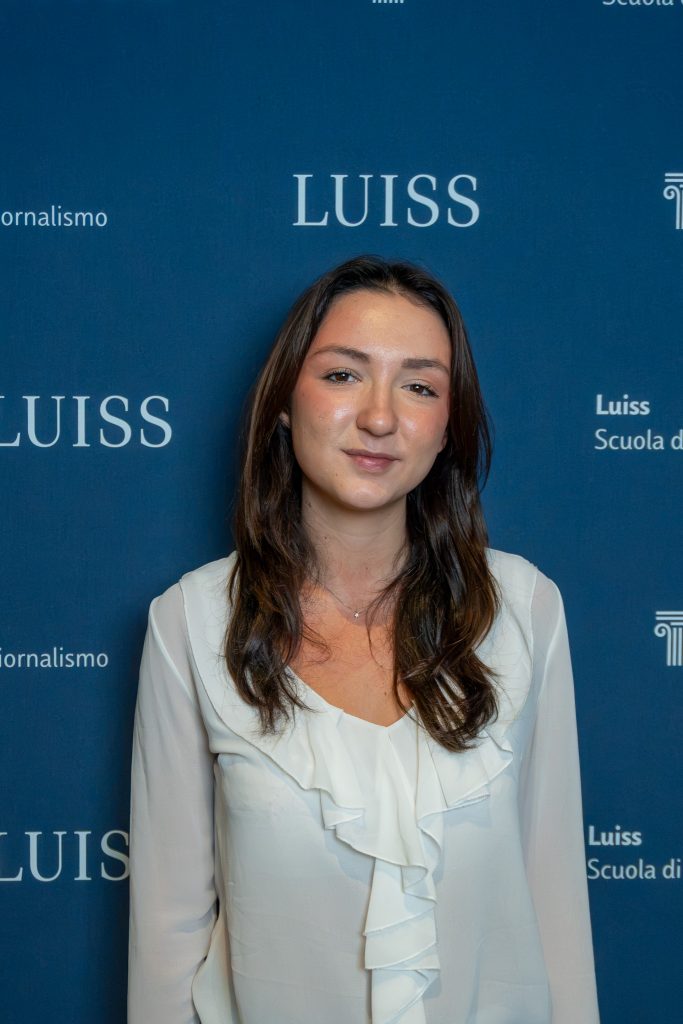
“I arrived at LUISS without having completely decided which branch of journalism I wants to specialize in and I’m fine with that uncertainty”. At the same time, there is one characteristic she knows she still needs to work on: “My directness: I consider myself a very direct person, something that can be useful in journalism but sometimes needs to be adjusted. One example comes from my final year of high school, when I was class representative. During a class council meeting, I spoke about an incident I felt had been unfair to me and my classmates. I was still angry, and because I tend to be very direct, I expressed my frustration quite openly”
Looking back, I realized that my anger became more noticeable than the actual issue I wanted to address. If I had explained the situation more calmly, I would have communicated my point more effectively.
That experience taught me that being direct can be a strength, but that the way you communicate matters depending on the situation. I think this is especially important in journalism: being willing to ask difficult questions while remaining clear, objective and in control of your emotions”.
One of the journalists she admires most helps explain what she means. “Growing up, I used to watch Carta Bianca, hosted by Bianca Berlinguer. I admired Berlinguer not only as a woman in journalism but also for the way she conducted interviews and maintained her principles throughout the program”. Giulia sees something of the journalist she wants to become in that approach: direct, committed to her ideals, but capable of developing the tools necessary to communicate them professionally.
For now, she does not know exactly where journalism will take her. It could be politics, international affairs, war reporting, or a field she has not yet discovered. What she knows is that the curiosity that began with a newspaper in her father’s hands is still there.
Only now, she wants to be the person telling the story.