

“I like to look at content before form”: with these words, Maria Cristina Ferretti encapsulates her own approach to the fashion industry. “There is so much more to learn other than fabric and seams; the way we dress is a reflection of how we live and behave. I want to explore this world from a cultural point of view. Looking at it as a constantly evolving language is what fascinates me”. Being a curious person, Cristina cannot wait to look into the infinite shapes her passion can take.
Born in Rome in 1995, Cristina grew up between the city and its outskirts. “A city girl on a temporary move,” she says. “From the city you take the speed, the constant stimulation. When I leave, I feel restless”. She needs some distance to think and process, but collects her material in the city’s chaos.
Cristina has always been into sports: from artistic gymnastics and ice skating to funk and jazz dance, sports led her into the show business. “Dance, like fashion, is a study of the body, inside and out. You learn when to stand in the light and when to hide in the shadows. Somehow, you learn to live in symbiosis with a group, which will later become society.”
On screen, she has always been attracted to Kat Stratford, played by Julia Stiles in the movie 10 Things I Hate About You. Kat is direct, unafraid of judgement and never plays a part for anyone else. “She doesn’t bend and she is silently rebellious; Kat is an outsider who doesn’t look like one, and perhaps this is exactly what makes her relatable”.
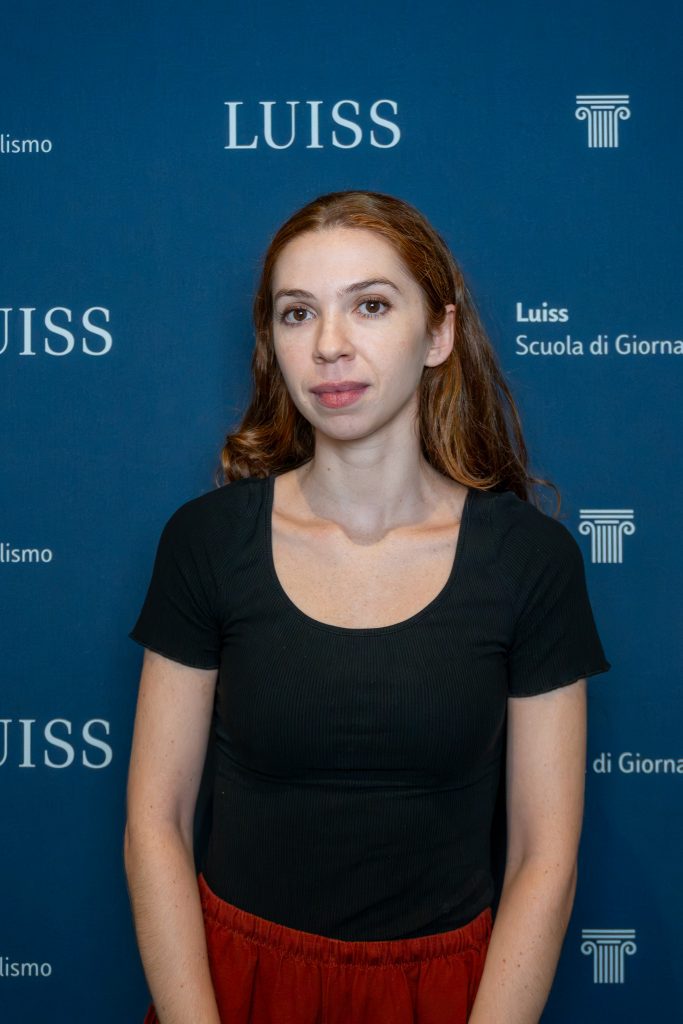
Cristina holds a Bachelor’s in Fashion and Costume Sciences, a Master’s in Fashion Studies and an executive course in fashion communication. “I studied the philosophy of fashion. I see everything from a critical point of view, I can connect themes and I enjoy doing that”. But it has not always been the case. “I feel like I developed a disenchanted view, I feel stuck between something I’m passionate about and an environment that constantly triggers my criticism”. When she got to know the fashion industry, beauty felt flat and superficial. “Journalism allows me to dig deeper and get to the heart of the matter”.
This revelation came through a short film produced by Miu Miu, a high-tier fashion brand, featuring white moths moving calmly in a comfortable, quiet environment. The film was designed to present a closed and protective feminine world: “It did it in a very abstract way, yet it felt familiar, I understood it”. That was the moment when Cristina realized the power of communication.
According to Cristina, fashion has folded under the weight of business; it seems to have become passive and neutral when it comes to highlighting social themes. “Brands would no longer risk hosting a show just to send a message. I would like to see a more responsible industry again. Not everyone can separate the idyllic world that brands like to present to the audiences from the reality we live in. It can create an illusion”. For Cristina, fashion should send a clear message: “I can show you beauty, but remember it can only exist if the world we live in exists”.
Cristina opts for “no-logo” clothes. She prefers to give personal, moral value to what she wears, rather than an objective one. This is a way of starting the shift she really wants to see in the wider fashion panorama, and she is studying to do so: “I know a lot of theory and too little practice. I want to turn skills into concrete abilities. One day, I hope to have a say in how fashion communicates”.