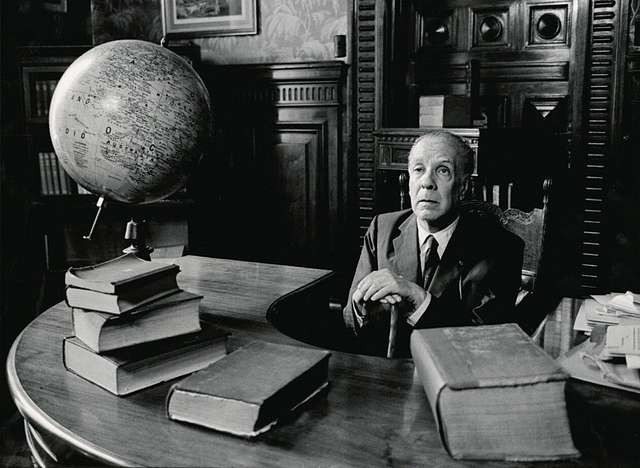

“It is often said that all roads lead to her; it would be better to say that she has no end, and that at whatever latitude we may be, we are in Rome,” wrote Argentine writer Jorge Luis Borges, for whom the city was less a physical place than a space of conceptual imagination where history, myth, and idea intersect. Rome became a symbolic architecture of the infinite, a maze of recurring images with the city at its centre.
This duality is at the heart of the exhibition Borges. El oculto nombre de Roma,, hosted at Casa Argentina from 12 May to 30 June, managed by the Argentine Embassy in Rome and organized with the Department of Foreign Languages and Literatures at Roma Tre University, home to the Argentine Chair.
Borges’ work redefined modern literature through short stories and essays that merge fiction with philosophy. His writing is marked by enduring ideas of infinity, labyrinths, memory, and the blurred boundary between reality and imagination. In many ways, Borges understood identity as something porous, once remarking: “I am not sure I exist, actually. I am all the writers I have read, all the people I have met, all the women I have loved.”
Against this literary background, one of the most distinctive aspects of the exhibition is its treatment of Borges and Rome, described by Camilla Cattarulla, coordinator of the Argentine Chair at Roma Tre University, as a Borgesian paradox: “a city that loved him, studied him, and celebrated him continuously, but which he personally experienced more as an idea than as a place.”
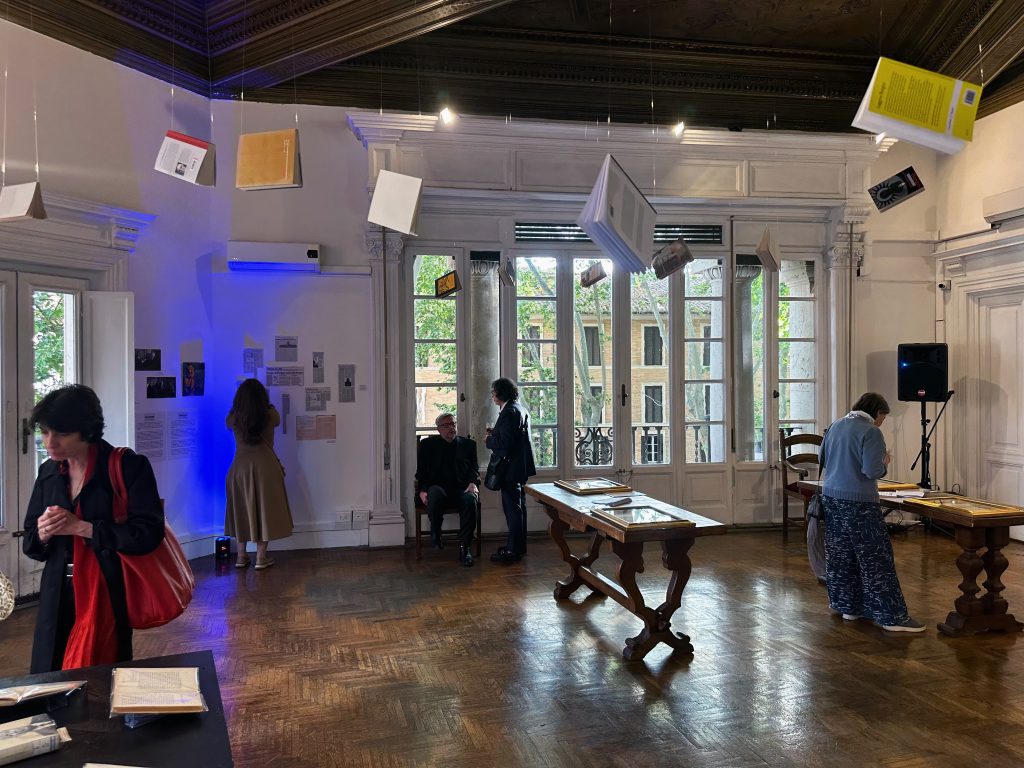
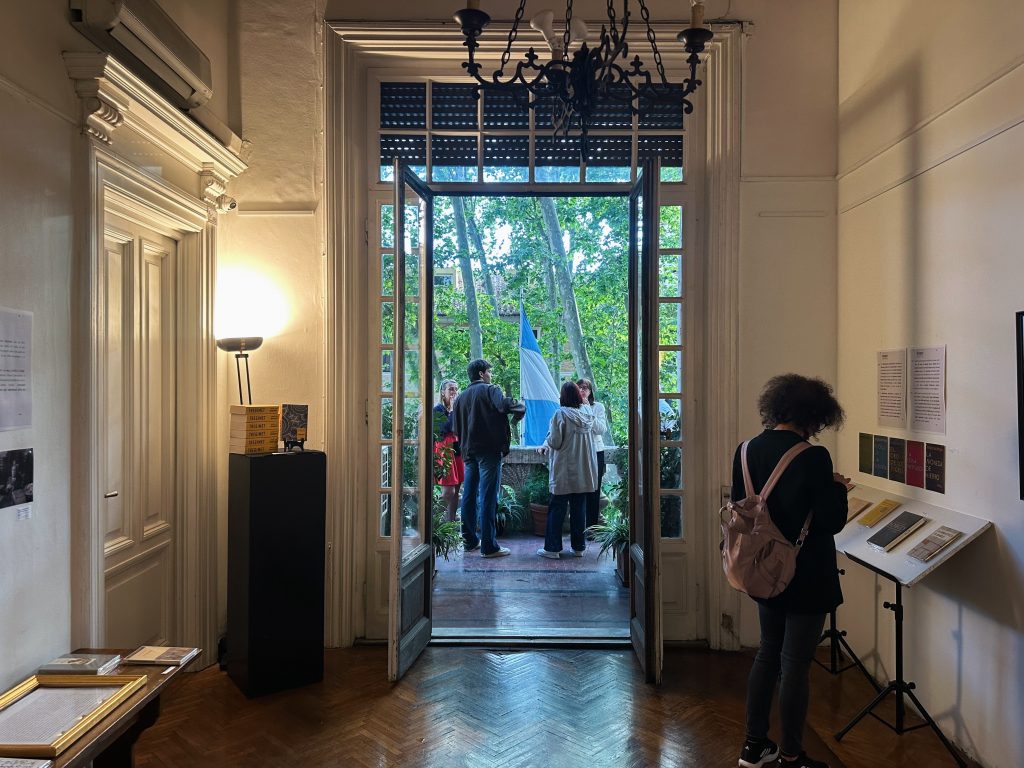
This tension between lived and imagined space becomes visible as visitors enter Casa Argentina on opening night. Located on Via Veneto, a street emblematic of the film La Dolce Vita and Italian cinema, the 1920s villa serves as a key hub of cultural exchange between Italy and Argentina. The fading evening light filtered through the building’s tall glass doors while the wind lifted the blue and white flag outside. Inside, the last rays of sun cast a warm glow over suspended copies of Borges’ most celebrated books hanging from the ceiling like fragments of an infinite library, while enlarged prints of his poems lined the walls.
In the background, the unmistakable sound of Balada para Jacinto Chiclana drifted through the rooms, a tango composed by Astor Piazzolla with lyrics written by Borges himself. Its slow bandoneón carried the melancholy of old Buenos Aires, evoking cobbled streets, fading myths, and the ghostly edges of the city Borges often turned into legend. Beneath it, the murmur of the crowd rose and fell as guests moved between the displays, discussing Borges’ labyrinthine worlds over glasses of red wine. Nearby, the warm scent of freshly baked empanadas filled the air, adding a distinctly Argentine note to an evening shaped by a writer whose work moves between the local and the universal.
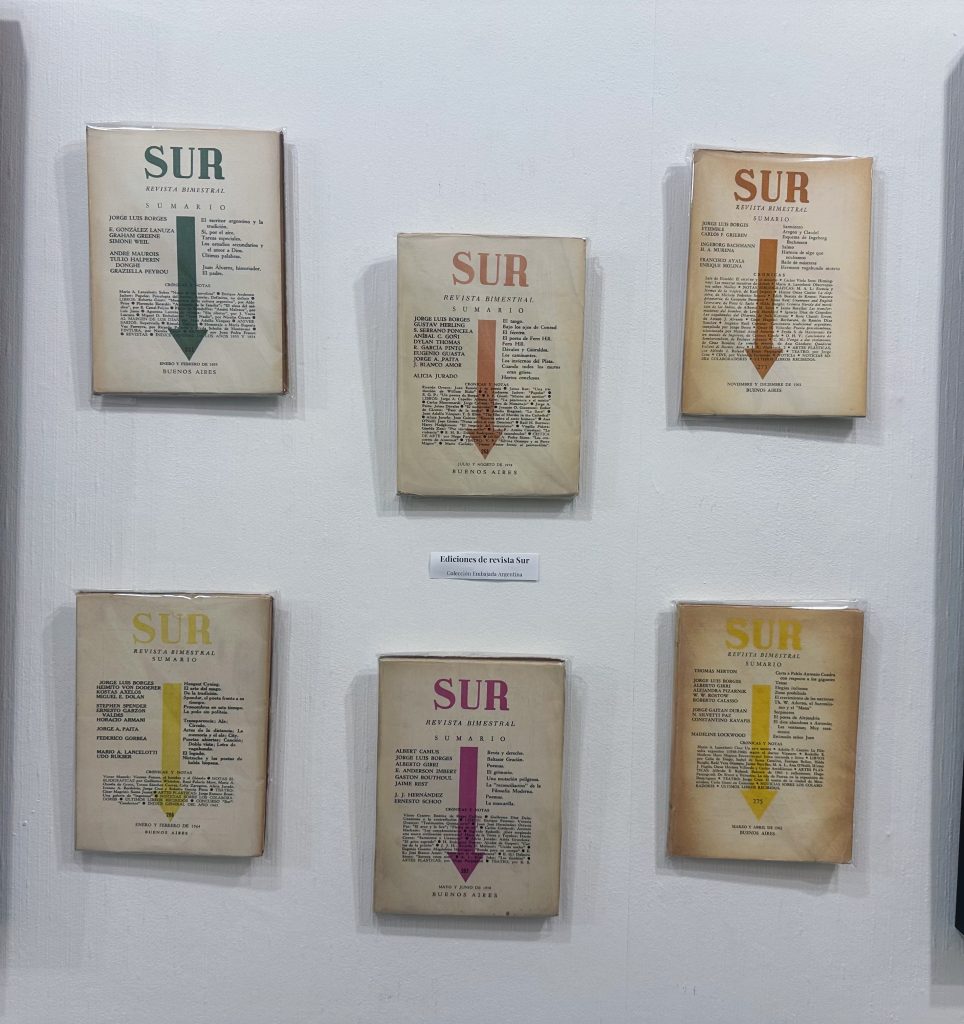
From this sensory landscape, the exhibition moves into Borges’ publishing history. On display are original issues of Sur magazine from the collection of the Argentine Embassy in Italy. These are key publishing spaces in the history of modern Latin American literature. It was in Sur, one of the most influential literary magazines of the 20th century, that several of Borges’ most important short stories first appeared, later collected in Ficciones and El Aleph, two works that define his literary legacy.
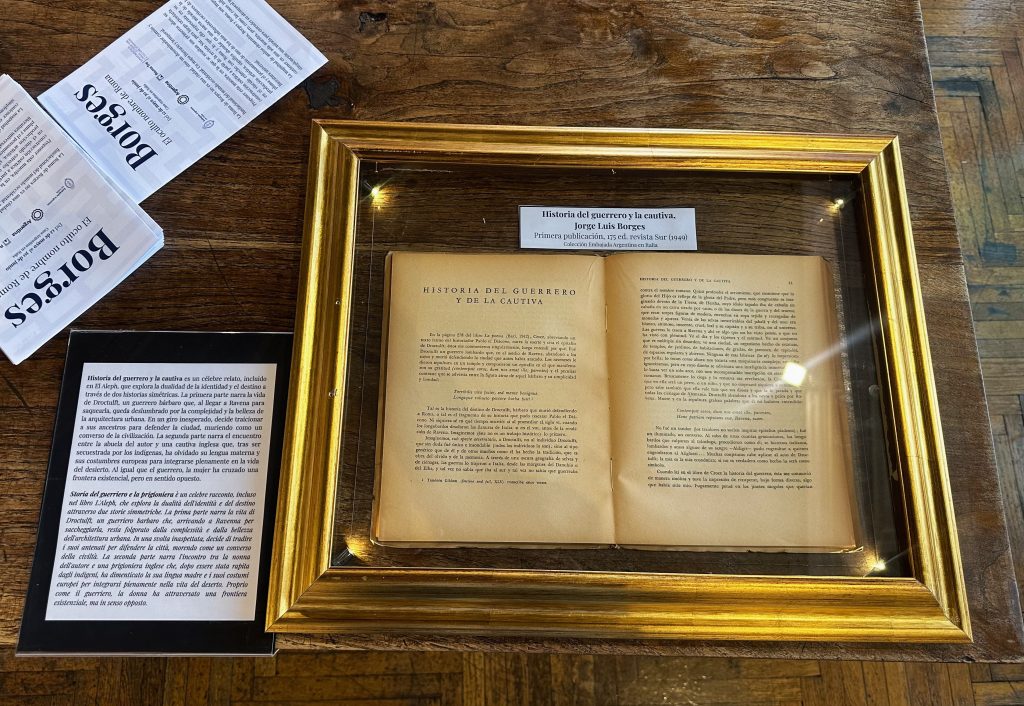
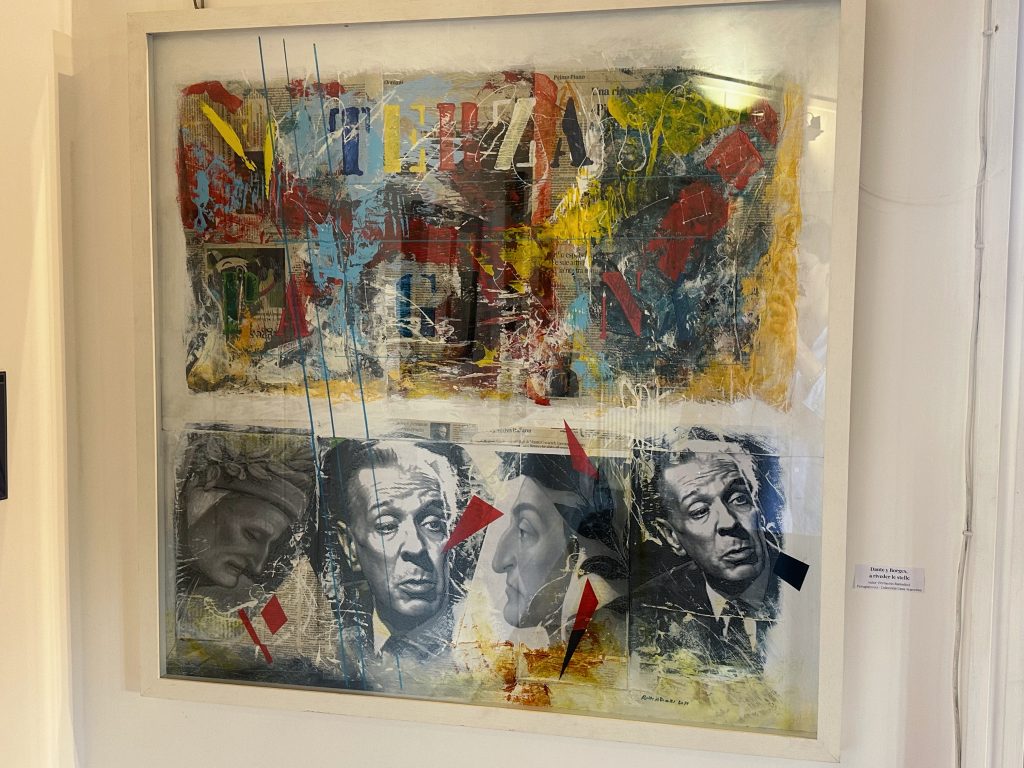
As Cattarulla explains, Borges never dedicated a whole text to the Italian capital as he did for Buenos Aires, “however, Rome is present in his paradigms: in the classicism that permeates his verses, in the cyclical conception of history, in the superimposition of past and present that characterises eternal places.”
In his poem Una brújula, Borges imagines history as if it were written in an infinite language, where names like “Rome” and “Carthage” function not as places but as symbolic elements in the story of the world. Within this vision, Rome represents a key force in shaping Western civilization rather than simply a city, becoming a point where Greek philosophical thought and Jewish moral tradition are brought into contact and reworked into a shared cultural foundation. This reflects Borges’ broader belief that “the history of the world is the history of a few metaphors.”
The exhibition title itself, Borges. El oculto nombre de Roma, (Borges. The hidden name of Rome) draws on an ancient myth that Rome possessed a secret, sacred name known only to a few priests and kept hidden because speaking it was believed to expose the city to danger or loss of protection. Borges was drawn to this story and anchors his ideas on the power of language.
In his short story Tres versiones de Judas, an imaginary theologian uncovers a shocking reinterpretation of Christianity. Borges suggests that revealing a forbidden truth about God could be as catastrophic as revealing Rome’s secret name.
The exhibition closes on a reflection by Cattarulla that captures the essence of Borges’ Rome: “Perhaps the most interesting truth is that Borges inhabited Rome without living it. He inhabited it as one inhabits an idea: the city where all traditions converge, where centuries speak to one another, where memory is so vast that it becomes indistinguishable from invention.” Borges’s Rome remains what he once described it as an endless city that we continue to wander through with his words.