
For decades, El Salvador was internationally known for its high levels of violence, corruption scandals involving successive governments, and gangs that controlled entire territories, extorted business owners, and threatened the lives of thousands of citizens. From a woman selling fruit at a local market to the owner of a small business, no one was entirely safe from gang violence. Previous governments were also accused of negotiating with these criminal organizations.
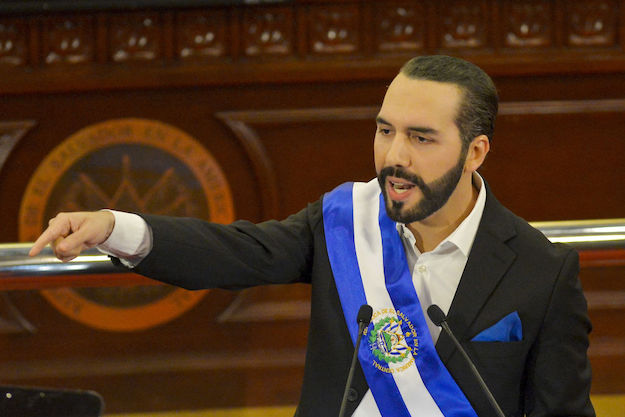
In 2019, Nayib Bukele came to power. A young president who broke the country’s traditional two-party system, he quickly built enormous popularity. In 2021, his party, Nuevas Ideas, secured a supermajority in the Legislative Assembly, consolidating the political power needed to push through major institutional changes.
In March 2022, following a weekend in which more than 80 people were murdered, Bukele declared a state of exception to combat the gangs. His strategy delivered significant security results: homicide rates fell dramatically, and the Salvadoran government reported a rate of 1.3 homicides per 100,000 inhabitants in 2025. However, behind these results lie several questions that must be considered before presenting this model as a formula that other countries can replicate.
The state of exception, which remains in force, suspends certain constitutional guarantees and has enabled mass arrests. While thousands of detainees had links to criminal organizations, human rights organizations have also documented arbitrary arrests, due process violations, and cases of people imprisoned without sufficient evidence. According to these reports, factors such as physical appearance, tattoos, place of residence, and unverified accusations have contributed to some arrests.
The problem is not only the risk of imprisoning an innocent person, but also the difficulty of obtaining a review of their case and securing their release. Families searching for their loved ones, people denouncing wrongful arrests, and individuals who spend months or even years in prison before being released illustrate the human cost that mass detention policies can entail. What safeguards protect citizens when the authorities make a mistake?
Building a maximum-security prison to isolate criminals responsible for murders, extortion, and other serious offenses can be part of a legitimate security strategy. However, the use of these prisons as propaganda showcases, combined with the concentration of political power and the prolonged use of exceptional measures, raises questions that extend far beyond crime and public safety.
This is where one of the main obstacles to replicating the Bukele model emerges. Not every country would be willing to restrict judicial safeguards for an extended period or accept such a concentration of power in the executive branch. In a democracy, public security must coexist with institutional checks and balances, judicial independence, and the right to legal defense. These safeguards are not obstacles that should automatically be removed during a crisis; they also protect citizens against abuses by the state itself.
El Salvador has undergone an extraordinary transformation in terms of public security, but a fundamental question remains: what will happen when reducing violence is no longer the country’s most urgent priority, while the state of exception remains in force and other challenges demand attention? What guarantees exist that extraordinary powers will not become permanent?
The Salvadoran case shows that a security strategy can produce significant results in a specific context. It does not, by itself, prove that the same approach will work in every other country. Criminal organizations, institutions, legal frameworks, and each society’s relationship with civil liberties differ.
The question, therefore, is not simply whether other countries can imitate Bukele, but whether they are willing to accept the same institutional and human costs in the hope of achieving similar results.