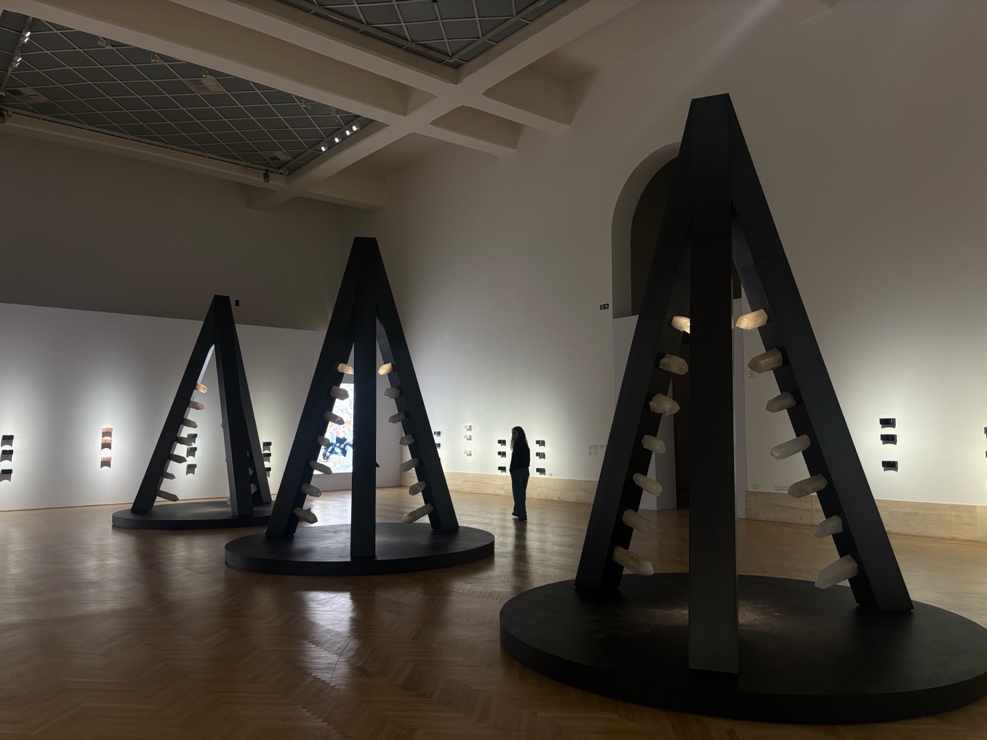


Quartz suspended over wooden beds, columns studded with protruding minerals, spectators encouraged to lie back, close their eyes, and be present. These are just some of the works featured in Marina Abramović’s latest exhibition.
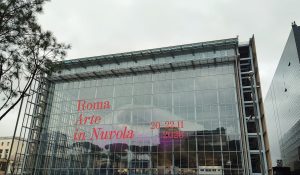
Exploring time through minerals and the Earth, rather than traditional methods of measurement, Marina Abramović’s Historical Works and Transforming Energy opened on 18 November at the National Gallery of Modern and Contemporary Art in Rome. Marking the artist’s 80th birthday, the exhibition is divided into two sections and, in the words of Abramović, “allows the public to see how the ideas at the basis of my work have evolved over time”.
Curated by Andrea Tarsia, Historical Works includes some of the most iconic pieces of the artist’s career. From Rhythm 0, the 1974 performance during which Abramović stood still for six hours whilst the audience interacted with her body using 72 objects, to Balkan Baroque, the 1997 installation in which she washed a pile of bones whilst projections of her parents and of herself, dressed first as a doctor and then as a dancer played in the background, the exhibition illustrates a walk through the artist’s career. The works reflect her longstanding focus on the body, presence, duration, and audience interaction, and demonstrate how over the decades these elements have shaped performance as a space for shared experience and connection.
At the centre of it all, however, is Transforming Energy, curated by Shai Baitel, artistic director at the Modern Art Museum of Shanghai, in close collaboration with Abramović herself. The exhibition includes a selection of Transitory Objects, a series the artist has been working on for more than three decades. Among the pieces are wooden beds with quartz hanging above them and columns with minerals protruding. Abramović “invites visitors to slow down”, lie back, close their eyes, and experience what the artist defines as a “transmission of energy”. The work thus transcends its physical form, becoming complete through the bodily presence and engagement of its audience. In a space dedicated to slowing down and reconnecting with oneself, one visitor reflected on stillness as “a basic dynamic that we are all losing.”
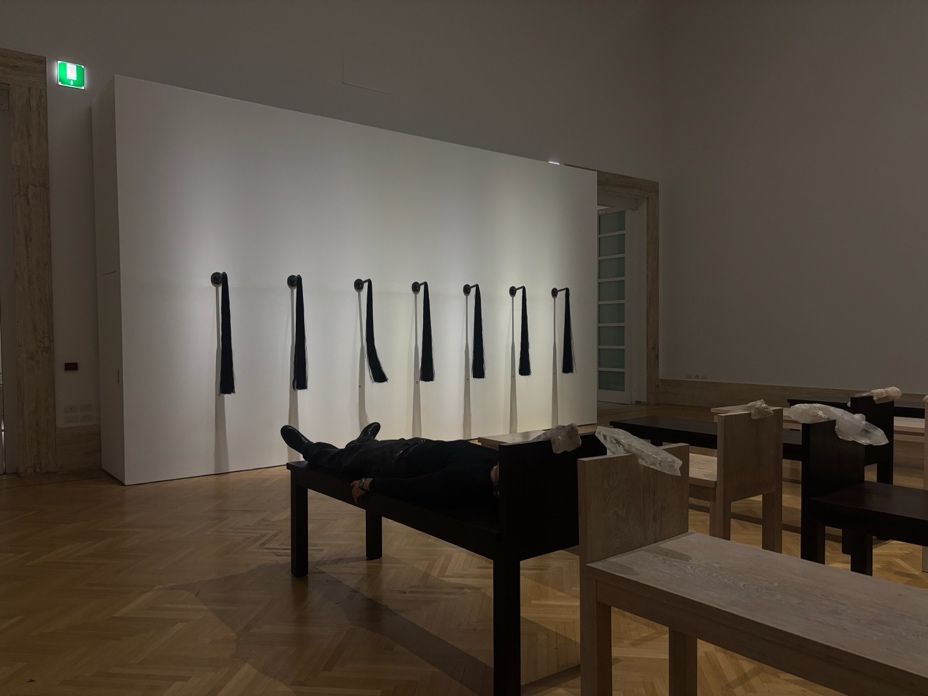
Wooden beds with quartz hanging above them which visitors are encouraged to lie down on.
Through the Transitory Objects, Abramović’s exploration of the body extends beyond the immediacy of performance to consider a distinct conception of time: the geological time of minerals and the Earth. The materials used in these works are the result of natural processes that have unfolded across geological eras, introducing a timescale vastly different from that of human experience. Stone beds, structures, and sculptural forms made from quartz, amethyst, agate, and other minerals serve as points of interaction between the artwork and its visitors, inviting them to engage with the materials through touch, presence, and physical experience. Abramović’s interest in crystals, particularly their relationship with energy and the human body, deepened significantly following her journey along the Great Wall of China in 1988. It was during this experience that she encountered principles of traditional Chinese medicine, helping to shape her understanding of the connections between the body, energy, and matter. Throughout the works, the body serves as a vessel through which different temporalities, energy, and matter intersect.
Bringing together works from different periods, the exhibition offers a glimpse into the evolution of Abramović’s artistic practice, showcasing how her explorations of presence, time, the body, energy, and human connection have transformed over the years. From her early experiments in performance to her later understanding of art as a space for shared experience and interaction, the works highlight the constantly changing relationship between the artist, the artwork, and its audience, who becomes an active participant rather than simply an observer.