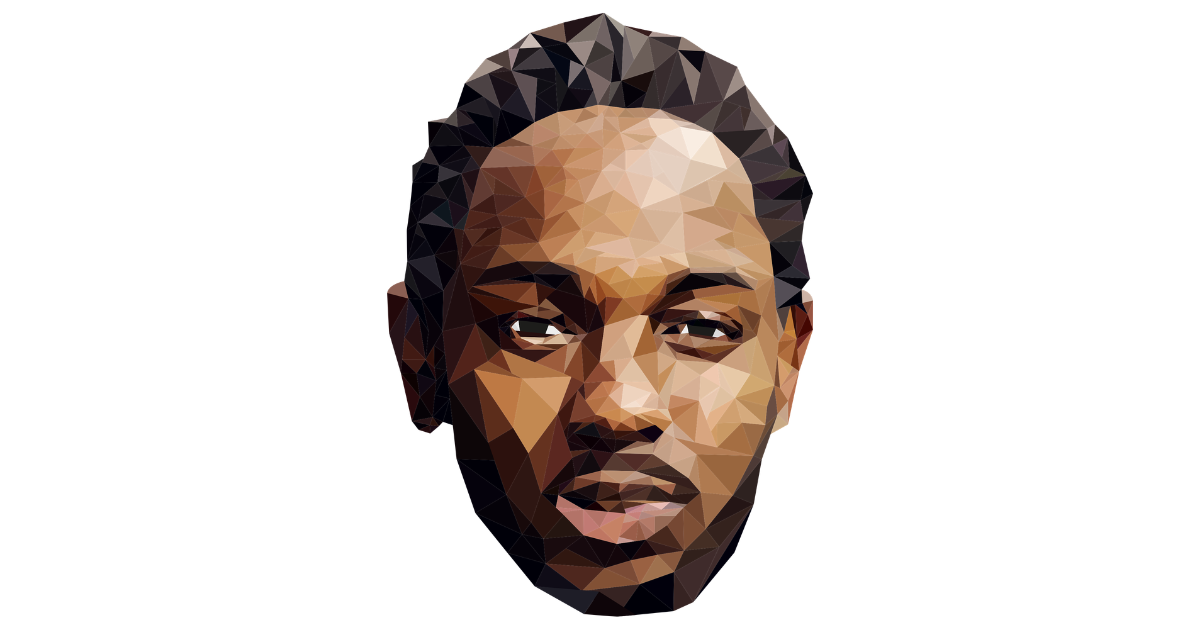

The opening of “Fear,” from Kendrick Lamar’s 2017 album Damn, drops you into a kitchen in Compton without warning. The voice is shrill and jagged, a seven-year-old boy narrating the rules of survival under his mother’s roof. By the second verse, the timbre has shifted: harder now, flatter, a teenager mapping the geography of gang violence and wondering if he’ll make it to adulthood. By the third, Lamar is at twenty-seven, and the voice has evolved into something exhausted and interior, cataloguing the paranoia that comes with fame, the fear of losing the creativity that got him there. Three verses. Three voices.
“I’ve always been heavy on vocal tone,” Lamar told Rick Rubin for GQ in 2016. “Different tones for me just give off different expressions.” It is a modest description of what is one of the most sophisticated vocal techniques in contemporary music. Across a career that spans more than a decade and a register that stretches from cartoonish falsetto to darkened baritone, Lamar treats his voice not as a single instrument but as an entire orchestra. Each register carries a different emotional weight, a different body, a different relationship to the world being described.
What makes “Fear” the clearest proof of this is how little Lamar explains. He does not announce the transitions between ages; he trusts the voice to carry the information. When the timbre changes, the listener understands the context without being told: we are elsewhere, and the fear being described belongs to a different body.
It is a technique closer to dramatic monologue than conventional rapping, closer, even, to theatre. And it connects Lamar to a tradition far older than hip-hop. Tommaso Di Dio, a literature professor at the Università degli Studi di Milano, has studied Lamar’s work in the context of Western poetic tradition. He sees in the vocal repetitions of tracks like “FEEL.” something structurally ancient. The litany, the incantation, the biblical preaching mode, “the saying seems almost less important than the rhythm with which you say it,” Di Dio has observed. “If you don’t say it following this rhythm, you’re not praying.”
Di Dio also identifies specific micro-techniques that underpin the vocal shifts. Lamar uses what poetry calls diaeresis, the splitting of a vowel to accommodate metre, stretching “mutual” into “mutu-al” to land on a particular beat or collapsing words across line breaks to reshape meaning mid-phrase. “This is a genuine treatise on rhythm,” he says. “He is truly a virtuoso.” When that virtuosity reaches a high enough pitch, Di Dio argues, it produces something beyond admiration: a kind of hypnosis.
What this clarifies is that Lamar’s vocal technique is inseparable from its musical context. These texts cannot be fully read on the page; they must be heard. Lift a Kendrick verse out of its production, and you strip it of its primary instrument. The voice needs the beat to complete itself; the beat needs the voice’s modulations to stay alive. It is a closed system, and its closure is part of what makes it so powerful.
Nowhere is that range more concentrated than on To Pimp a Butterfly (2015), the album widely recognised as the fullest expression of his vocal range. and the one where the voice becomes the primary site of internal conflict, political outrage, and sorrow.
“The Blacker the Berry” is the album’s most confrontational moment, tracking institutional racism and the cycle of self-hatred with a delivery to match. Lamar’s voice moves between a venomous near-shout and something closer to a wail, fury and grief refusing a single register. The repetition in “You hate me, don’t you? / You hate my people, your plan is to terminate my culture” mimics the relentlessness of the oppression it describes, while “You unleashed a demon that’s reverting to his primeval state” drops into something guttural and pre-linguistic, the voice dragged beneath the reach of words.
It is here that Di Dio’s point about African ancestry becomes most legible. Cultures in which literature lived entirely in the voice, in breath, rhythm, and communal transmission rather than on any page, run beneath the surface of what Lamar does. “I hear these artists going back to find the African root and bringing it into the West,” Di Dio points out. The voice modulations, the incantatory repetitions, the voice pushed past composed expression: these belong to a tradition driven underground by the Middle Passage, surfacing here with the force of something long suppressed.
When Lamar’s Damn was awarded the Pulitzer Prize in 2018, the question of whether hip-hop constitutes literature arrived in mainstream conversation with institutional force. But the terms of that debate may already be too narrow. What Lamar does with his voice exceeds what any literary prize category is designed to measure, because it exceeds what the page can hold. He is a poet who performs his work, a performer whose work is constituted by performance itself, in which the voice is a vehicle for meaning.
The boy on “Fear” is a performed character. His fear lives in the pitch, the tension, the way the voice works hard to contain something it cannot quite hold. Strip that away, and what remains is a transcript. What Lamar offers is something more precarious and more alive: a voice that becomes whoever it needs to be, and in doing so, makes the listener feel exactly what it is to be them.