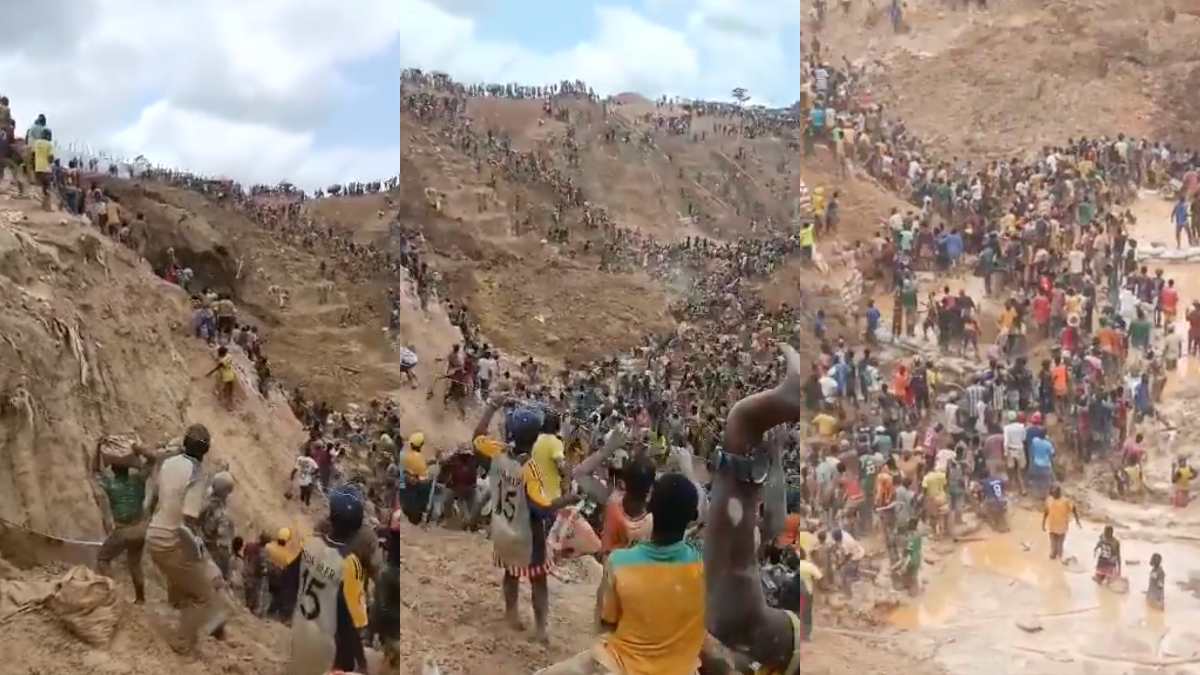

The ground gave way beneath hundreds of people. On August 19, an artisanal gold mine collapsed at Zamboyé, in the Central African Republic, about 30 miles from the town of Baboua, near the border with Cameroon. At least 100 people were killed, according to international news agencies, and local authorities say the mining camp is home to more than 45,000 people.
The collapse is a tragedy. But behind it lies a much larger system, one built on precarious work, exploitation and almost no oversight. To understand the forces at play, Zeta spoke with two experts. Francesca Caruso is an analyst, co-founder of the Peace Agreements Monitor and a specialist on the Central African Republic. She is also a mediator with the Community of Sant’Egidio, a Rome-based Catholic organization known for brokering peace talks in conflict zones, including the Central African Republic. Luca Raineri is a political scientist at the Sant’Anna School of Advanced Studies in Pisa who researches conflict, natural resources and mining in Africa.
First, it’s important to distinguish between two kinds of mining in Africa: industrial and artisanal. “Industrial mining involves large companies and is heavily mechanized, so it can extract huge quantities of resources,” Raineri said. “The downside is that it hires few local workers. It mostly needs specialized staff, often brought in from abroad or from the capital, but because it runs on contracts with governments, it is easier to tax and track, and through royalties it gives at least something back to local communities, in the form of social investment. “Then there is artisanal gold mining. It relies on little machinery and on miners who organize themselves, so it employs far more people and spreads income across a larger share of the population. But it often operates informally or illegally: without permits or concessions, without paying royalties to the state, and without meeting safety or environmental standards.
Sometimes governments don’t notice, because the operations are small and temporary, Raineri said. Other times they knowingly look the other way, reasoning that local communities gain more from direct access to the gold than from the arrival of large foreign companies, often Canadian or Australian, that dominate industrial mining. “These sites, however, often spring up in very poor areas and can turn into places of extreme violence and crime,” Raineri said. “Weapons, banditry, drugs and prostitution fuel conflict and insecurity, while the miners, mostly men with no other options, are lured by the promise of quick money.”
There is another distinction, between illegal and informal mining sites. The two are different, Caruso explained, “even though they are very often lumped together. “Illegal mining is large-scale, well-financed and coordinated. It operates without a license and is often tied to criminal networks and corruption,” she said. “In the 1990s, people talked about ‘blood diamonds,’ controlled by armed groups that used the profits to fund their wars, as in Angola, Sierra Leone and Liberia. The same thing is happening today in Sudan. Informal mining, on the other hand, is small-scale and labor-intensive. It’s the work of so-called artisanal miners: individuals or communities without a license, driven by poverty and a complete lack of alternatives.”
By that definition, Zamboyé was a legal, registered site, but an informal one.
“It’s not an isolated case, and it’s a growing phenomenon, in Africa but also in Latin America, where poverty, record gold prices and an absent state produce the same kind of mines,” Caruso said. “Accidents happen with a regularity that says a lot about working conditions. In the Democratic Republic of Congo, two landslides a few weeks apart at the Rubaya mine, between January and March of this year, killed hundreds of people. The death tolls were never confirmed.”
So who actually controls these mines in the Central African Republic? “It’s hard to say precisely,” Caruso said. “There is little official data, the state does not fully control its territory, and it is a country we know very little about. There is very little research on the ground.”
The players vary, from small registered businesses to outside actors such as Russia’s Wagner Group, which reportedly controls strategic gold sites in exchange for fighting armed and rebel groups, which in turn exploit mines of their own. There are also Chinese and Rwandan operators with regular permits. Everywhere else, there are artisanal diggers and the middlemen who buy from them.
Perhaps surprisingly, the Central African Republic is not even among Africa’s leading gold producers. Its output is so modest that the World Gold Council doesn’t list it separately, folding it instead into an “other countries” category, far behind the continent’s top producers.
“Gold can serve as currency to pay mercenaries for their services,” Raineri said. “The forces once known as Russia’s Wagner Group were deployed and, in some countries, later rebranded, merging into the so-called Africa Corps, which reports directly to the Kremlin. These forces get paid for what they provide, and sometimes the payment comes in kind, through access to mineral resources such as gold. In several Sahel countries, for example, access to certain gold mines may have been part of the deals between governments and Russian forces.”
“In this sense, the Central African Republic is a particularly significant case, I would say a crucial one,” he added. “For a long time it was the main hub of Russia’s presence in Africa. Other countries may have overtaken it today, but it still matters a great deal. Russian forces have a strong presence there and considerable influence over national politics.”
Caruso, however, urges caution. “If we focus on what happened, the tragedy of the mine collapse, I would take the attention away from Wagner, which is too often the only story our newspapers tell about this country,” she said. “I would look instead at structural problems that, unfortunately, would not disappear on their own if Wagner left. The government has opened an investigation into Zamboyé to determine who is responsible. The opposition, meanwhile, is blaming the government for failing to regulate and police these mines.”
“That said, this is an extremely fragile country, and a vast one. Even if it wanted to, it does not have the means right now to prevent tragedies like this one overnight. Two days before the collapse, the owner had closed the site because of the rains. But the miners went in anyway. Dozens of soldiers are now guarding the entrance, with official estimates ranging from 20 to 100, but those numbers are ridiculous compared with the number of people living around the mine. In fact, the soldiers couldn’t stop the miners.
“Given how fragile states on the continent are, and how areas beyond government control keep forming almost as a matter of course, the risk of more tragedies like this one is high.” Caruso concluded.