

«Trump handles foreign policy like a mafia boss»: this is how Ian Buruma describes the contradictions of the American president in an exclusive interview with Zeta. The Dutch writer and professor of Human Rights and Journalism at Bard College in New York – author of Occidentalism, Year Zero, and Stay Alive: Berlin 1939-1945 – analyzes the US-Iran conflict, the Maga movement, and the role of the Western democracies in today’s crises.
Do you see Trump’s handling of the war with Iran as a coherent strategy?
«I see it as the improvisation of a president who doesn’t really know what he is doing. He thinks that foreign policy can be conducted in the way a Mafia boss does business, with violent threats and financial inducements».
Could Trump’s approach strengthen the Iranian regime?
«Yes. Even Iranians who hate the regime will resent threats to “destroy their civilization”. Also, just by managing to survive, the regime can claim a victory and crack down harshly on civilians at home. This is especially true, if Iran manages to keep control of the Straits of Hormuz».
Is political storytelling prevailing over effective strategy in this war?
«Yes. But that has always been Trump’s method. He is a TV personality. Showbiz is everything».
Does Trump’s approach to politics reflect a shift from rules-based international order to a more personalized system?
«Of course. But that is true of his domestic politics as well as his foreign policy. Outside the US, he would like to make deals with fellow autocrats. Inside the US, he has turned the Republican Party in to a personality cult»
Who benefits most from this cycle of escalation and pause?
«China and Russia».
If, as you argued in “Bombing for freedom”, bombing civilians never leads to regime change, why do leaders still rely on it?
«It looks easy. The strategy was originally devised by men who were traumatized by the trench warfare of World War One, when hundreds of thousands of soldiers died in a few days. Bombing seemed quicker and less costly in military casualties. Drones have probably made both trench warfare and massive bombing obsolete».
What alternatives exist to military intervention for promoting democratic change in authoritarian regimes?
«Democracies can encourage people who live in dictatorships with soft power: opening borders to refugees, offering education programs, expanding such news sources such as the BBC World Service, as well as putting pressures on authoritarian regimes by linking business opportunities to the improvement of human rights».
The MAGA movement has been called fascist by certain historians. Do certain elements Trumpism resemble historical fascism?
«I wouldn’t call it fascism, but there are certain echoes of the fascist past: the personality cult of the great leader, the undermining of judicial independence, the attacks on the free press, punishiment of political opponents and critics, the barrage of propagandistic lies».
In Stay Alive: Berlin, 1939–1945, you show how people normalized authoritarian rule and illiberal leadership. Do you see similar patterns emerging in Trump’s America?
«I’m not sure people normalized the Nazi regime. But people do adapt to the politics of their times by conforming, keeping their mouths shut when it is risky to speak freely, making deals with autocrats, pretending that bad things aren’t happening. But history has also shown – in China in 1989, for example – that people can rebel very quickly when there is an opportunity to do so. Rebellion against oppression is just as much a part of human behavior as conformism is».
Do the survival strategies you describe help us understand how civilians in Iran respond to war and authoritarian pressure today?
«Iranians, like the Chinese, or Germans under Hitler, sometimes conform to dictatorship out of opportunism – to get jobs, power, money – but mostly because it is too dangerous to revolt. Iranians are no different from other people. Many often conform, and many rebel whenever there is a chance. Whether the war will be an opportunity is still hard to predict».
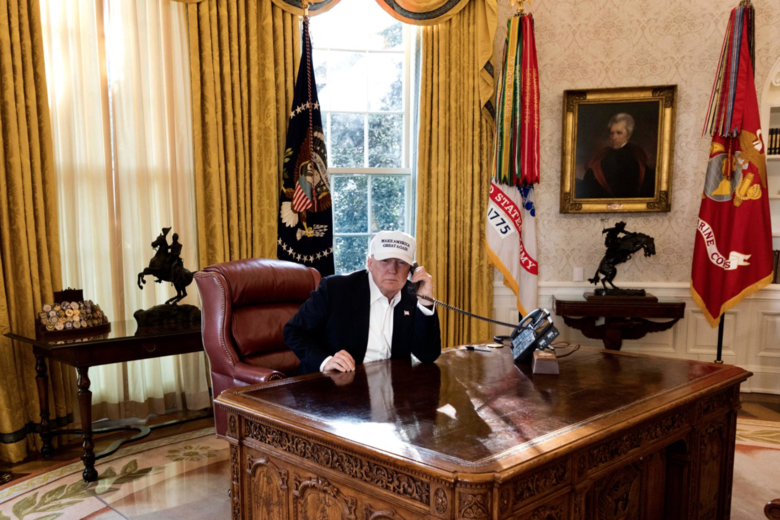
Picture credits: White House